
ACM Update 16-02-26

Following the first round of central bank meetings, FX markets were much calmer last week. The January US jobs data showed growth, but there were heavy revisions to the 2025 figures overall. US inflation got back to 2.4% last month and the UK saw more mediocre economic growth for December.
This week starts off with a bank holiday in the US and ends with the advance GDP reading for Q4. Sandwiched in the middle is a raft of UK data, from unemployment to CPI inflation and retail sales.
The US Dollar had a yo-yoing week, as mixed economic data confused markets. There were both positives and negatives, each of which could be used to suggest future monetary policy decisions from the Federal Reserve.
Starting off with the jobs data, Wednesday’s slightly delayed release saw a stronger than expected performance in January, where 130,000 new jobs were added to the US economy. Unemployment ticked lower, down to 4.3% from the 4.4% of last month. This gave some relief against concerns of a slowing economy. Hiring was primarily in health care and construction, whilst the financial sector was one of those shedding jobs.
However, it was the significant revisions to the 2025 jobs data, that created concern. This heavily revised down the number of jobs added for the full year, from 584,000 to 181,000. The figures are a far cry from the 2.2 million and 3.0 million jobs added in 2024 and 2023 respectively.
Despite the downward revision logically suggesting a greater chance of an interest rate cut in March, the more current 130,000 new jobs for January balanced out the bad data.
One factor that did lean markets towards potential rate cuts though was the January inflation reading. This took inflation down to 2.4% for the month, from 2.7% in December. Much to the satisfaction of Jerome Powell, this puts inflation just off a five-year low heading into the next Fed meeting. The committee will have another month of inflation data by that stage, but markets are currently pricing in roughly a 10% chance of a rate cut in March.
Other data releases saw a flatlining retail sales sector, which didn’t expand at all from November to December. The US Federal Budget Balance figures meanwhile demonstrated a smaller deficit than a year ago. These saw tariffs collected totalling $30bn for the month and over 300% up in this fiscal year to date (since October) vs the previous.
There was plenty going on politically and geopolitically also. Domestically, Trump’s tariff agenda took a hit as a handful of Republicans broke ranks to pass a bill in the House to remove tariffs on Canada. Whilst Trump can ultimately veto this, it does send a message of dissatisfaction from within.
Another US Government shutdown is underway, albeit a partial one this time. For now, this primarily impacts the Department for Homeland Security but is unlikely to be resolved any time soon as Congress is on a break until 23rd February. This marks the third shutdown of Trump’s second term.
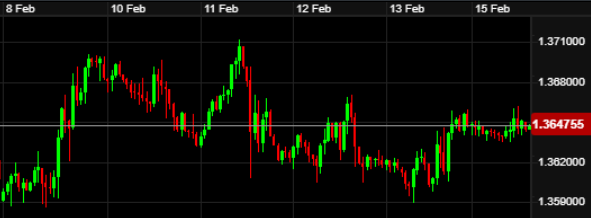
Sterling-Dollar traded flat overall for the week, with a range of less than 1% despite the significant data releases. Movements on the pair can be seen in the chart below:
The gloomy story of UK growth was back in the spotlight for the Pound. December’s GDP figure produced a sluggish 0.1% expansion, resulting in a net 0.1% growth overall for Q4. The November figure was revised down from 0.3% expansion to 0.2%. The ONS (Office for National Statistics), perhaps politely, described the overall growth picture as “subdued” for the back part of the year. This put the overall growth for 2025 at 1.3% and marginally up on the 1.1% the year before.
Chancellor Rachel Reeves was quick to point out that the UK was “the fastest growing of the European G7 economies in 2025”. Reeves admitted there was still “more to do” but 2026 would be the year that the British public would start to feel the positive impacts of Labour’s changes.
The biggest concern though was in the all-important Services sector, which saw no growth at all in Q4 for the first time in two years. The small overall growth had come from the Manufacturing sector, whilst Construction suffered its worst quarterly performance in four years. The OBR is predicting 1.4% growth for the coming year, the International Monetary Fund 1.3% and the Bank of England just 0.9%.
On which note, policymakers from the central bank are seeing expectations rising for more interest rate cuts in 2026. Following the latest 5-4 split, there seems to be an increased appetite for rate cuts amongst the nine policymakers.
Two of the committee spoke at events last week, both of whom voted to keep rates at their current level the week before. Catherine Mann is keen to avoid tariff-driven inflation, thus sees it vital to keep interest rates where they are for now. She also compared the UK’s current “pedestrian” growth rate to a “horse and pony”.
The Bank’s Chief Economist, Huw Pill, thinks interest rates may already be “a little bit too low”. He remains focused on wage growth keeping inflation sticky overall and wants to keep with the cautious and gradual mantra. Despite the comments from the two, markets are currently pricing in between a 50% and 85% chance of a rate cut in March, leading to some GBP weakness.
The British currency was also weakened by political instability during the week. Uncertainty around Sir Keir Starmer’s leadership, slipping approval ratings and a series of high-profile resignations, all weighed heavily on the currency.
On the continent, ECB policy stability remains a beneficial factor for the Euro. Speeches from President Christine Lagarde and Bundesbank head Joachim Nagel, both reiterated the data-dependent and meeting-by-meeting stance that markets have become accustomed to.
Both also believed that the recent dip in inflation to 1.7% will be short-lived, expecting the metric to stabilise at the 2% target in the medium term. This continues to reassure markets that any potential rate cuts are a long way away, if at all.
Growth data for the bloc showed 0.3% growth in Q4, producing 1.3% worth of annual growth in 2025. As with other economies, the final quarter was slightly more sluggish than the earlier part of the year. Joachim Nagel spoke in reference to growth also, suggesting the German economy should expand by 0.6% this year, with inflation coming back close to target. A better performance from the Eurozone’s biggest player would help the currency considerably.
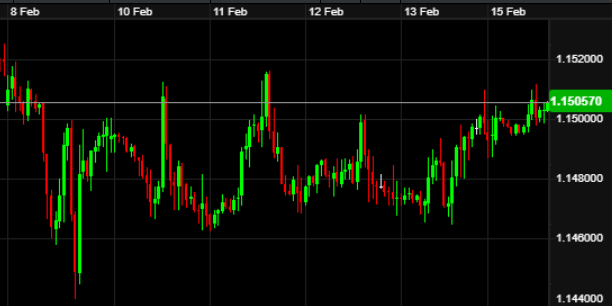
Investor confidence also jumped by six points in the last month, hitting the highest reading since June as continental positivity continues. The Euro itself traded relatively flat across the majors throughout the week, with the GBP-EUR chart below:
The week ahead:
Monday – US & CANADA BANK HOLIDAY, ECB Nagel speech (17:40)
Tuesday – UK Unemployment/Claimant Count/Average Earnings (07:00), ZEW Economic Sentiment (10:00), Canada CPI inflation (13:30)
Wednesday – RBNZ rate decision (01:00), UK CPI inflation (07:00), US Durable Goods Orders (13:30), Fed meeting minutes (19:00)
Thursday – ECB Economic Bulletin (09:00), US Unemployment Claims (13:30)
Friday – UK Retail Sales & Public Sector Net Borrowing (07:00), EU/UK/US Services & Manufacturing PMIs (08:15-14:45), US Advance GDP & Core PCE inflation (13:30),
This week will start off on a quieter note, with Monday a public holiday in both the US (President’s Day) and Canada (Family Day), as well as all week in China for the New Year.
US data is therefore mainly spread across the latter half of the week. The two big releases from the States will be the minutes of the last Federal Reserve meeting (published on Wednesday evening) and the dual release of Advance GDP for Q4 and Core PCE inflation. The Fed minutes will be especially pivotal as they will provide an insight into the level of disagreement on the committee, as to policy direction.
The UK has a number of data releases throughout the week. UK inflation, published on Wednesday morning, is forecast to show a drop to 3.0% in January, which if correct would mark the lowest figure in nine months. Such a move may well sway the 5-4 balance on the Monetary Policy Committee, to vote in favour of a cut come their next meeting on 19th March.
Other UK releases feature unemployment, wage growth, retail sales and Government borrowing, spread throughout the week.
In Europe, releases are limited. Aside from the latest PMI readings for the Manufacturing and Services sectors (also applicable to GBP & USD), the latest ECB Bulletin and ZEW Economic Sentiment figures are the only points of note. Those are aside from a speech from Joachim Nagel late on Monday afternoon.
With plenty of market data released this week, especially for GBP, get in touch with the Aston team to discuss any upcoming payments you may have.
Have a great week.
