
ACM Update 30-03-26
FX markets remain driven by events surrounding the Iran war as we head towards Easter. After suggestions of a de-escalation from Donald Trump last Monday, the US Dollar initially weakened before recovering by close of business on Friday. Oil and energy price spikes are rippling through markets, impacting currencies as a result.
This week we should see the inflationary impact of the Middle East conflict in data form with a March CPI indication for Europe, as well as all the latest employment figures from the US, prior to the Easter weekend.
Once again, the US Dollar was driven by the direct and indirect impact of events in the Middle East last week. Last Monday saw financial markets breathe a sigh of relief as Donald Trump announced a pause in some of the US attacks. The President cited “very good and productive conversations” regarding a potential “complete and total resolution” of hostilities.
Despite suggestions that Iran “wants to make a deal” from Trump, there were conflicting reports about such a scenario. Thus, a sharp weakening of the US Dollar on Monday eventually rebounded throughout the week. Similar could also be said about oil prices, which fell on the prospect of calm, then bounced back. Trump extended his pause on attacking energy infrastructure and power plants, later in the week.
With the confusion surrounding what the truth was, investors who had ditched the safe-haven Dollar on Monday, gradually flowed back into it throughout the week. With oil prices spiking once again and the commodity being priced in USD, the currency took a boost as a result.
Within the US, domestic data remained resilient. Despite some performance indicators cooling a little, Manufacturing and Services PMI figures held on enough not to alarm the Federal Reserve. This is despite business activity slipping to an 11-month low. Consumer inflation expectation figures though hit a 12-month high, mixed with consumer confidence dropping off.
The firmer than expected performance data, along with inflation pressure saw markets aggressively repricing Federal Reserve interest rate expectations for 2026. Projections have now largely wiped out the chance of any interest rate cuts for 2026, boosting the Dollar considerably. The previous mantra of “higher for longer” now looks to be very much the case again.
So, despite Donald Trump’s Monday comments, the Dollar closed out the week in a stronger position than prior to the announcement. This week’s jobs sector and unemployment figures will be key to determine any direct impacts from the Iran war domestically.
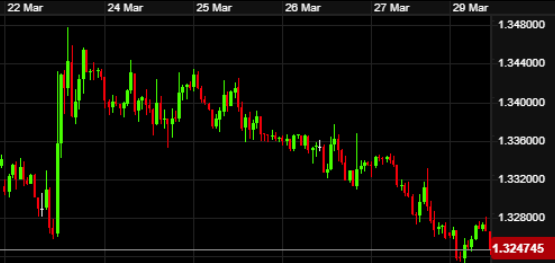
Last week’s movements on GBP-USD can be seen in the chart below:
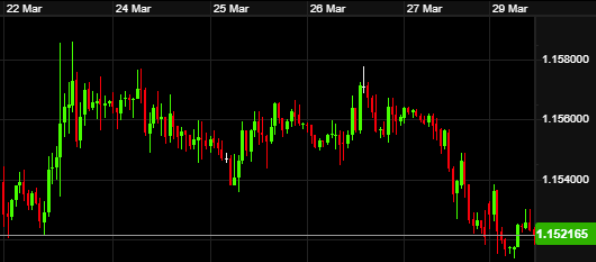
Apart from against the US Dollar, GBP produced a steady week. Sterling-Euro for example moved within a range of less than 0.5% from Monday to Friday. However, the events in Iran are also having a direct impact on the UK economy, more so than other G7 nations according to the latest OECD report. The body moved to downgrade the UK 2026 growth forecast to just 0.7%, from the previous 1.2%.
Also projected to move is UK inflation, according to the same figures. This is projected to hit 4% this year, as energy and fuel prices soar. For February at least, prior to the Iran war starting it must be said, UK price rises remained stable at 3.0%. Given wage growth is the lowest since the pandemic at 3.8% in the most recent figures, spending power is likely to be squeezed in the coming months.
All of the above is bad news for Rachel Reeves’ bid for economic growth. Despite this, the Chancellor believes the Government has “the right economic plan” in place, even with the war in Iran.
UK data releases showed improvement in the Manufacturing sector in March, but a slowdown in the larger Services sector. A disappointing February for UK retail sales saw a -0.4% contraction, which admittedly was better than estimates had feared. It was however the biggest contraction since October. Government borrowing was larger than expected, raising more concerns about fiscal stability and UK debt interest payments.
The forecast spike in inflation has led markets to once again reprice UK interest rate forecasts. The recent hawkish hold from the Bank of England has now seen the potential for interest rate hikes priced in, offering some support to GBP.
Four of the nine BoE policymakers spoke last week, providing key insight into potential future policy. The Bank’s Chief Economist, Huw Pill, warned that the “fog of uncertainty” must not lead to a lack of policy action. Pill has for some time suggested rates are too low and has an eye on energy price hikes as a result of the conflict.
Sarah Breeden was more cautious, suggesting not to rush to any conclusions before the April meeting. By this point the panel will have more current data at their disposal.
Megan Greene believes that there could be lasting implications for UK inflation, even if the conflict de-escalates promptly. She stated it is “wildly optimistic” to expect energy prices to normalise within two months and is primarily concerned about the impact on inflation, more than economic growth.
Alan Taylor meanwhile sees the opposite to Greene. He sees the energy shocks as temporary, forecasting limited implications for medium-term inflation, but instead is focused on growth as a concern. He reaffirmed that the threshold for further rate rises remains high.
An interesting mix of opinions from four of the nine rate-setters. Arguably two for an April rate hike, one to hold and one on the fence awaiting more information.
On the continent, the European Central Bank have noted recently how vulnerable European nations are to energy price hikes. We received an early indication of this on Friday, where the Spanish Flash CPI indication was released for March, covering the period of the Iran war.
This showed a spike from 2.3% to 3.3%, largely driven by oil and energy prices. Admittedly, this was under the 3.6% markets were expecting. The same figure for all Euro nations combined is released on Tuesday morning, expected to have jumped from 1.9% to 2.5%.
Markets have already begun to price in two ECB rate hikes for 2026, which is quite a reversal from a month ago when conversations were still based around one cut. This follows weakening economic sentiment, after consumer confidence figures fell sharply to -16.3 in March, the lowest level since 2023.
ECB President Christine Lagarde spoke at an event last week. She was direct about energy price shocks, suggesting policy would be geared around the shock’s persistence, second-round inflation risks and maintaining a range of options. Lagarde also opened the door to “measured” rate adjustments, if inflation persists above target.
Fellow ECB decision maker Joachim Nagel also spoke in a speech titled “Vigilance and Readiness”. The head of the Bundesbank echoed the need for a swift response if needed, stating the ECB should consider raising interest rates as early as their 30th April meeting.
Movements on GBP-EUR last week are below:
The week ahead:
Monday – German Prelim CPI (10:00), Fed Powell speech (15:30)
Tuesday – UK Final GDP (07:00), EU CPI Flash Estimate (10:00), US JOLTS Job Openings & Consumer Confidence (15:00)
Wednesday – US ADP Non-Farm Employment (13:15), US Retail Sales (13:30)
Thursday – ECB Economic Bulletin (09:00)
Friday – UK & EU BANK HOLIDAY, US Non-Farm Payrolls & Unemployment (13:30)
A brief reminder to clients that clocks went forward in the UK (& Europe) over the weekend, so we are now back on BST. Equally, this week is a shorter week for the Easter bank holiday weekend in the UK, thus the Aston offices will be close on Friday 3rd & Monday 6th April.
With Q1 coming to an end, this week provides us with further insight into how much oil and energy prices are influencing inflation. Following Friday’s Spanish Flash CPI release, the EU-wide equivalent for March is published on Tuesday morning, with a spike expected.
In the UK, Tuesday morning will also see the final GDP figure for Q4. This is expected to confirm a tiny 0.1% growth for the period, even prior to any of the recent events geopolitically. Being a short week, other UK data is limited.
US market data is more frequent, kicking off with a Monday afternoon appearance from Jerome Powell. The Fed Chairman speaks at Harvard University, where questions on monetary policy going forwards are likely.
Aside from this, the latest round of US employment data will be filtering through in the second half of the week. The headline Non-Farm Payrolls and Unemployment figures will be published on Friday, which is not a bank holiday in the US. The jobs sector was already showing signs of a slowdown before the uncertainty of the Iran conflict, thus it will be interesting to see how that has developed in March.
The foreign exchange picture remains one of high volatility, primarily driven by events in the Middle East. This looks likely to remain the case for the foreseeable, adding further levels of unpredictability to foreign exchange exposures. To avoid leaving any FX conversions open to market movements, get in touch with the Aston team to discuss how best to protect your bottom line and avoid unnecessary market risk.
Have a great week and enjoy the Easter break for those who celebrate it.
