
ACM Update 26-10-26

Following a big few days of UK data, GBP continued to trend upwards as expectations build for a Bank of England rate hike next Thursday. In the US Fed statements were more cautious, whilst in Europe the French fiscal and political strain remained in the headlines.
This week the UK Autumn Budget, Federal Reserve and European Central Bank meetings all take place on Wednesday and Thursday. Both rate-setting committees look to be edging towards a hold in policy.
With AI uncertainty in the US, a raft of UK data to digest and continued instability in France, there was plenty to move markets last week.
We start off with the USD where the Dollar Index saw a second consecutive week of losses down to 101.50. This followed four weeks of gains previously which now feels like a distant memory. The reasons behind the Dollar weakening were varying, but we will cover the main areas here.
Easing Federal Reserve hawkishness has been a theme of late. The minutes of the most recent Fed meeting were cautious, with no indication of if or when further rate hikes would come. This was echoed by Chair Warsh who distanced himself from any projected rate hikes, most notably with “those aren’t my forecasts”.
Other Fed policymakers have also been more cautious and leaning towards a policy pause. New York Fed President John Williams stated last week that one further rate hike “may be appropriate late this year” but added there was “no urgency to act” straight away.
This was echoed by colleague Christopher Waller who reaffirmed that “hikes do not need to occur at consecutive meetings”. Philip Jefferson also stated the Fed may “take time to make its next interest rate move”.
These recent statements (and others) have limited any Dollar strength for now. The rate-setting committee look highly likely to hold US interest rates this Wednesday evening, leaving the following meeting on 9th December as very much “live”.
Movements in the equity and treasury markets also haven’t helped the Dollar of late. Concerns as to the huge capital investment and expenditure in the sector, saw funds instead flow into government bonds. This in turn led to an unwind in US Treasury yields, which saw the USD lose momentum.
The conflict in the Middle East continues to see the cost of oil at well over $100 a barrel. With the US suffering with higher inflation and high energy prices there seen as increasing recession potential, the Dollar has not gained from the recent spike.
Recent movements on GBP-USD can be seen in the chart below:
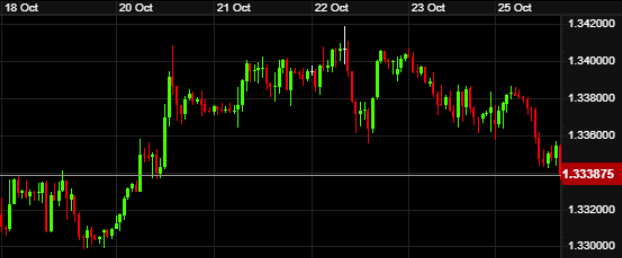
With the Fed leaning towards a policy pause, any chance of a rate hike from other major central banks is appetising for investors. In the UK, that is what we are facing in the run up to next week’s policy decision.
Bank of England rate hike bets continue to build, especially after last week’s data releases. A hot CPI inflation print of 3.5% was unsurprisingly pushed up by sharp increases in petrol and diesel prices in the year to September. This was both above the 3.4% markets had forecast and ticking up from the 3.1% recorded in August.
The higher inflation is a double-edged sword, as it has also been pushing up Government borrowing in September. The most recent ONS (Office for National Statistics) figures showed that the Government borrowed £24.5bn in the month, £1.8bn higher than a year before. UK debt is now over £3tn for the first time but fell as a proportion of the UK’s economic output which is the used measure.
All of this puts the Chancellor, John Healey, in a difficult position for this week’s Budget. Borrowing costs remain elevated, reducing his fiscal headroom. Healey is wanting to give “breathing space” to consumers and is expected to deliver a “cautious” Budget, leaving a lot of the difficult decisions to next year.
Other UK data releases were mixed. Unemployment came in at an under forecast 4.7%, marking the lowest reading since May 2025. The average earnings (wage growth) metric also fell by more than expected to 3.7%, from 3.9% the month prior. Despite running much closer to inflation than it has for a while, some Bank of England policymakers believe wage growth is not slowing quickly enough.
A better-than-expected employment market and wage growth remaining elevated are further factors that open the door for a Bank of England rate hike next week. Both indicate the economy could cope with/absorb higher rates in their current position.
Retail sales data for September showed a contraction of -0.4% however. This came following an upward revision to the August figure to 0.7% growth. The Flash Manufacturing and Services PMI releases were both nicely ahead of expectation. The UK economy looks to be on a good footing for now.
Onto the Eurozone and the unrest on the streets of France remains concerning. This comes at the same time as business activity is contracting in the country, as well as ongoing budget and debt concerns mounting. The scale of the damage caused in the country will have considerable financial implications for some time.
Energy price spikes are also causing concern on the continent. Last week saw a rise in the price of natural gas, which was bad news for Europe. The shift led to concerns about both sticky inflation and strangling growth generally.
Outside of this, with little expected from the ECB meeting this Thursday the Euro remains relatively flat. Recent comments from policymakers see the committee unlikely to go back-to-back this week and as with the Fed playing wait and see until their December meeting.
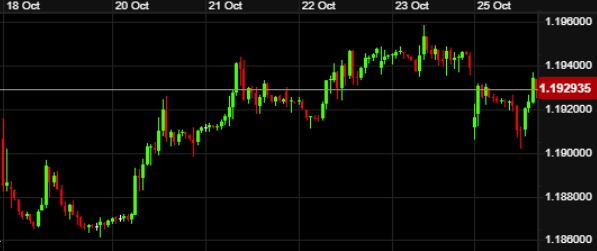
Movements last week on GBP-EUR can be seen in the chart below:
The week ahead:
Monday – UK CBI Realised Sales (11:00)
Tuesday – US Durable Goods Orders (12:30), CB Consumer Confidence (14:00)
Wednesday – RBNZ rate announcement (01:00), UK Budget (12:30), Bank of Canada rate announcement (13:45), Fed rate announcement (18:00) & Press Conference (18:30)
Thursday – US Advance GDP, Unemployment Claims & Core PCE (12:30), ECB rate announcement (13:15) & Press Conference (13:45)
Friday – Bank of Japan rate announcement (03:00), EU Prelim GDP (10:00)
We have plenty of big events this week, with central bank announcements and the UK Autumn Budget. Starting there, the Chancellor’s fiscal statement will begin shortly after 12:30 on Wednesday lunchtime in the House of Commons. This marks Healey’s first Budget, having taken over from Rachel Reeves a few months ago.
Healey’s predecessor made markets nervous as to her possible moves 12 months ago, whilst this time around there are more questions on unfunded spending. The Burnham-Healey combination seems to be saying “yes” to a lot of projects of late, but the maths is yet to be proven. We shall see how markets digest Wednesday’s events.
Later that evening, at the earlier time of 6pm UK following the clocks change, we have the Federal Reserve meeting. This is likely to deliver no change in policy from the Fed, for the reasons already covered in this newsletter. The usual Warsh press conference follows after, which may well follow his usual style of little forward guidance.
Thursday gives us the ECB equivalent meeting. Again, the committee seem highly likely to leave interest rates unchanged for now whilst they await more data. Further policy meetings are spread across the week from the central banks of New Zealand, Canada and Japan also.
With the US Midterms and also a Bank of England rate decision next week, we are likely to be in for a busy and volatile fortnight on the foreign exchange front. To learn more on how to remove risk from your upcoming currency requirements, make sure to reach out to the Aston team.
Have a great week.
