
ACM Update 23-02-26
It was another good week for the Dollar, as a more hawkish shift in the latest Federal Reserve minutes provided strength. Tariff talk and geopolitics were also beneficial factors for USD.
In the UK, inflation cooled as did employment data but a strong retail sales figure and private sector growth in January provided a slight bit of respite for GBP on Friday.
This week brings the latest on Eurozone inflation, speeches from Bank of England policymakers and what will inevitably be an interesting State of the Union address from Donald Trump.
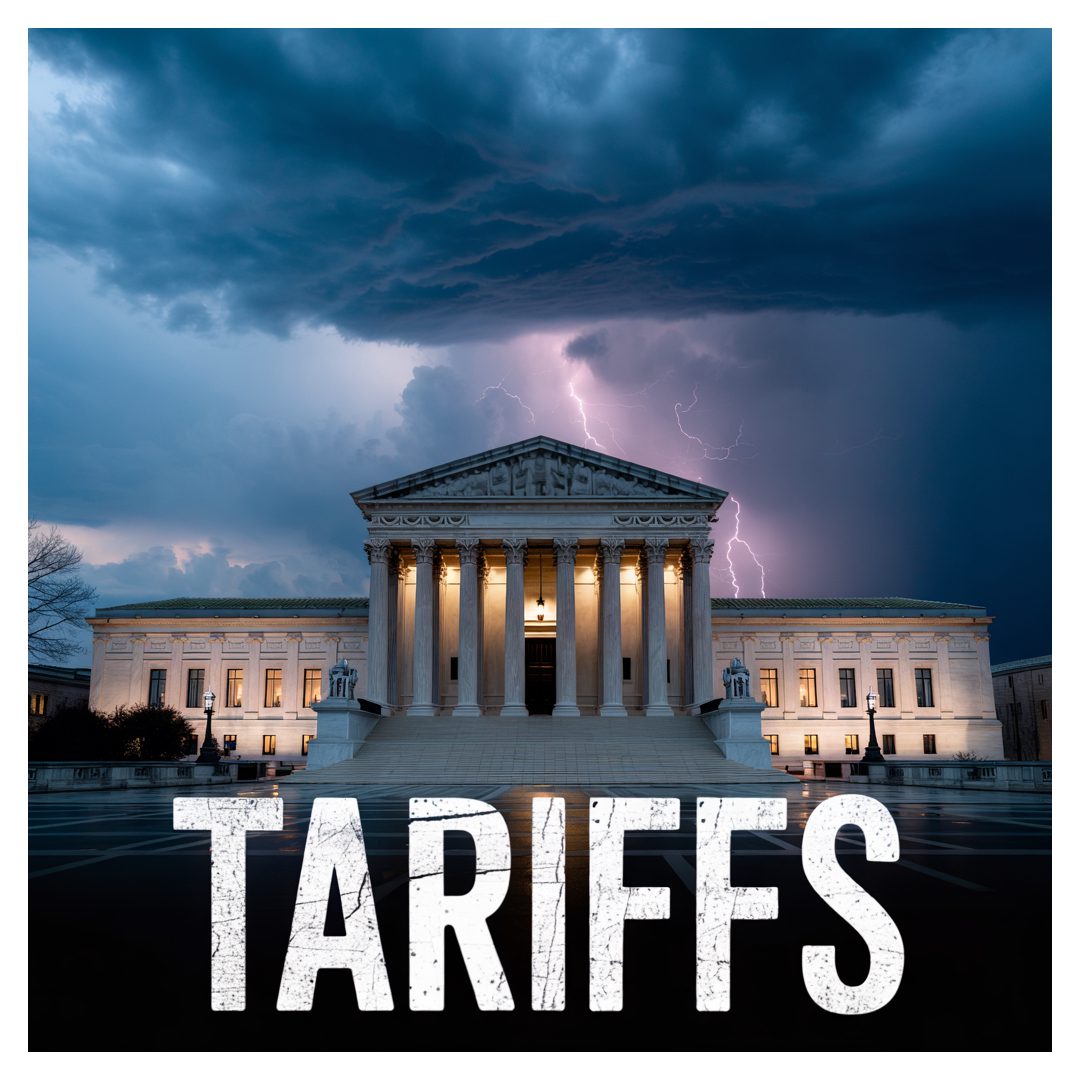
On the subject of the President, his tariffs came back into focus on Friday afternoon as the Supreme Court delivered their verdict on the legitimacy of such measures. The panel voted 6-3 that Trump had exceeded his legal authority by using the International Emergency Economic Powers Act (IEEPA) to impose tariffs.
Speaking for that majority, Chief Justice Roberts declared the law does not give the President “unbounded power” to unilaterally tax imports. This ruling reinforces the fact that the power to levy tariffs remains with Congress.
But their ruling only invalidates some of those introduced. Namely these are the “Liberation Day” baseline 10% tariffs across the board, as well as those additional measures against China, Canada and Mexico. Others related to steel and aluminium can remain. This opens the door for refund battles to take place, with some major US retailers already having filed claims.
Initial FX market reaction was limited, with the US Dollar weakening off marginally. This can easily be linked to the direct impact on the national deficit, expected to suffer to the tune of $2 trillion over the next decade. Financial markets on Wall Street rebounded positively. The White House intends to explore “alternative legal avenues” to reimpose duties and announced a 10%, then 15%, flat tariff rate on imports over the weekend.
In economic news, a more hawkish outlook from the Federal Reserve was one factor in boosting the US Dollar last week. More hawkish from some at least. For the first time in a while, the committee were split with suggestions of rate cuts, rate hikes and holding firm. Some voiced concern about the slow reduction in inflation in their decision.
As it was, the overall vote was for a hold, despite two dissenters on the panel, inevitably Trump picks who favoured a cut. The outlook gave markets confidence that US interest rates will remain where they are in the 18th March meeting, currently pricing in a 94% probability of another hold in policy.
There was further domestic positivity in the shape of the latest jobless claims figure falling by more than forecast. Another factor easing rate cut pressure on the Fed. But Advance GDP data for Q4 showed growth of just 1.4%, well short of forecasts and down from 4.4% in Q3. Trump blamed “The Democrat Shutdown” for taking “at least two points off” GDP for the period.
Geopolitics also played their part, as tensions rose between the US & Iran regarding nuclear talks. An ever-expanding US military presence in the region was also evident. This further boosted the safe-haven appeal of the Dollar.
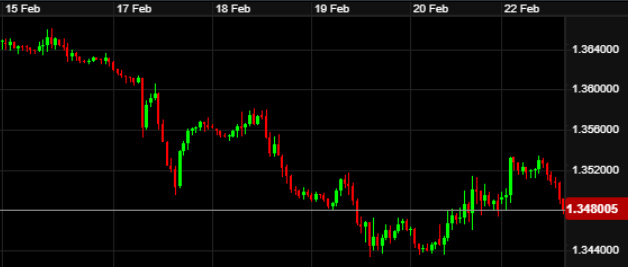
A stronger week for the Dollar then, especially versus GBP. Movements on the pair last week are below:
UK economic news was plentiful last week, but it was very much a mixed bag which offered little support for the British Pound. The Wednesday publication of January’s CPI inflation figure saw a sharp slowing, down to 3.0%. This marked the lowest reading since March 2025 and was driven by changes in fuel prices and the cost of some foods.
The slowing in inflation drew the customary pat on one’s back from Starmer & Reeves, with the pair claiming their plan was working. The latter suggested that further falls in the cost of living are expected, meaning conditions for “investment and growth in our economy” were trending positively too.
A slowing jobs market, however, is not a good sign for the duo. Figures for December, released on Tuesday morning, showed the unemployment rate hitting the highest level since early 2021 at 5.2% as well as a larger rise in those claiming benefits.
The same release also showed wage growth slowing again, now at 4.2% and the lowest in 16 months. This point is crucial for driving inflation and has been cited by Bank of England policymakers, such as Chief Economist Huw Pill, as a focal piece of data.
GBP did enjoy a slight data-fuelled bounce to end the week however. Friday’s releases of retail sales and PMI figures were both positive. The former saw a December to January jump of 1.8% in like-for-like sales, which was both the biggest monthly increase since May 2024 and well above expectations. The PMI release suggested UK private sector growth accelerating at close to a two-year high.
However, the combination of the above factors does increase the likelihood of a rate cut in the next Bank of England meeting. Falling inflation, slowing wage growth, a difficult jobs market and sluggish economy, all point to a cut being necessary and recommended. Markets are currently pricing in more than an 80% chance of a UK rate cut on 19th March.
The Euro also endured a tough week up against the resurgent US Dollar, as well as through weaker domestic data. ZEW Business confidence readings for Germany and the bloc as a whole came in under expectations on Tuesday morning. Consumer confidence meanwhile showed stability, with the reading at its best (least negative to be accurate) in four years.
To the negative were industrial production figures, which showed a -1.4% decline in December. Construction sector data, released later in the week, demonstrated a rise of 0.9% which helped offset the negative industrial number.
The ECB’s Economic Bulletin was also published, reporting a “resilient” Eurozone economy once more. The bank noted inflation falling to 1.7% of late but expects it to flatten out at the 2.0% target over the coming months. Unemployment is now at a low of 6.2% and overall policy is in a good place. Global uncertainties continue to be referenced.
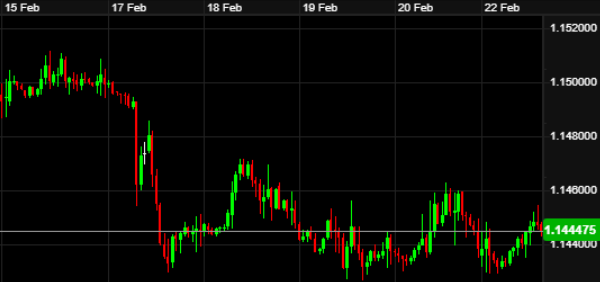
Sterling-Euro traded relatively flat on the week, as illustrated by the chart below:
The week ahead:
Monday – BoE Taylor speech (11:00), Fed Waller speech (13:00), ECB Lagarde speech (17:00)
Tuesday – US Consumer Confidence (15:00)
Wednesday – Trump State of the Union speech (02:00), EU Final CPI inflation (10:00)
Thursday – ECB Lagarde speech (08:30), BoE Lombardelli speech (09:00), US Unemployment Claims (13:30)
Friday – BoE Pill speech (13:00), US PPI inflation (13:30)
With the tariff war reigniting, we can expect this week to contain further fallout from Friday’s Supreme Court decision. Conveniently for the President, Donald Trump hosts his annual State of the Union speech in on Tuesday evening US time (early Wednesday in Europe). This will see the president addressing the current position of the country to Congress, whilst outlining his legislative agenda and priorities for the coming year. How many mentions of the word tariff, one wonders?
Outside of the above, US data is reasonably limited. Consumer confidence, the latest jobless claims figures and producer price inflation are the most important. These are spread throughout the week.
In the UK, little to no data of note. This leaves the stage clear for speeches from Bank of England policymakers, of which there are three talking during the week. Alan Taylor, who speaks on Monday, was one of the four votes to cut interest rates in the most recent meeting. Clare Lombardelli and Huw Pill, were both part of the winning majority to keep rates as they were.
Huw Pill’s speech in particular will be of interest. He recently stated he felt interest rates were already too low, citing wage growth as his justification. But with wage growth dropping in the most recent figures, has that opinion changed?
In Europe, inflation will be the main release. January’s initial reading was suggested as 1.7%, which is to be confirmed in this finalised figure. This shouldn’t cause much concern to markets, with the ECB confident it will bounce back to the 2% target in due course. A Christine Lagarde speech takes place on Thursday morning also.
A quieter few days of data to end February then, but geopolitics and the ever-present tariff developments of Donald Trump will remain important. Volatility remains high, heavily driven by the ebbs and flows of the US Dollar in recent weeks.
For any pending requirements, make sure to reach out to the Aston team.
Have a great week.
