
ACM Update 09-11-26
A Midterm majority for the Democrats, a unanimous (ish) MPC rate hike and buoyant Non-Farm Payrolls. November kicked off with a bang and saw plenty of movement on Sterling-Dollar as a result, whilst GBP-Euro remained at 19-month highs.
With the latest round of policy decisions behind us, this week is more focused on October’s US inflation, plus the latest on UK and EU GDP. Wednesday sees bank holidays in various countries.
With plenty going on politically and economically last week, Sterling-Dollar was always likely to be volatile. That indeed proved to be the case as the Midterms, UK interest rates and US data all drove the pair.
The early part of the week was quiet, very much the calm before the storm as markets awaited the Midterms. But by late Tuesday night, a Democratic landslide emerged which saw the Dollar begin to lose ground. Markets priced in a “divided” government scenario, seeing restricted spending and changes to tariffs.
The prospect of reduced combat with Iran was a hot topic following the results, which saw the Dollar’s safe haven attractiveness reduce. The Democratic victory also saw oil prices fall back, again cooling USD demand.
Initial reactions therefore led to a perceived fall in US inflation from markets. Lower inflation means less requirement for US interest rate hikes, again seeing a less attractive yield position for the currency and further weakening.
However, the Dollar came roaring back towards the end of the week. Thursday saw the Democratic sweep of the House and Senate sparking fears of tighter regulation on AI data centers and a general slowdown in the massive recent spending in the sector. The “tech wreck” led to a major Wall Street sell-off, leading investors straight back into the safe haven Dollar.
The Dollar gains were extended on Friday, with a blockbuster Non-Farm Payrolls figure of 165,000 new jobs added to the US economy in October. Market expectations were for a gain of just 65,000 roles. The gains came across a number of sectors, from professional services to healthcare, transportation to warehousing, manufacturing to AI and even general retail. Minor losses meanwhile were recorded in leisure and hospitality.
In addition, August and September’s initially weak figures were upwardly revised by a combined 84,000 jobs. This puts the US employment market in a significantly stronger position than had previously been thought. Headline unemployment also came down to 4.1%, the joint lowest since January 2025.
A buoyant employment market now boosts the chances of another US interest rate hike on 9th December. The strong performance shows the economy isn’t being suffocated by higher interest rates for now, giving the Fed wriggle room.
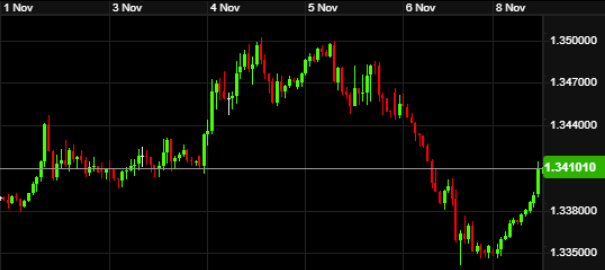
Overall, the Dollar gained against most majors last week. The GBP-USD chart is shown below:
In the UK, the Bank of England delivered their widely forecast quarter-point interest rate hike to 4.0% last week. This was the committee’s first hike since August 2023. The move being almost a certainty meant little upside for GBP against other currencies however.
Whilst the vote will go down as all nine members calling for a hike, there was one outlier. The ever-hawkish Catherine Mann wanted a bigger move and called for a 0.50% rate rise. Across the committee, domestic inflation was the main driver of the hike and a broadly hawkish sentiment remains.
Bank Governor Andrew Bailey commented that further hikes remain “highly probable” unless there is a major shift in the geopolitical climate. He stated quite directly though that “today’s increase shouldn’t be seen as the first in an inevitable long sequence of hikes”. Other more dovish members saw the increase as a “one for now” insurance move.
Bailey left the door ajar for a December hike, one which markets are pricing at a circa 50:50 for now. If oil prices remain high and/or there is further escalation in the Middle East in the interim, that could easily tip the scales. The Bank’s own updated inflation predictions see a peak of 4.9% by mid-2027, significantly up from July’s 3.2% forecast.
Aside from this, GBP ebbed and flowed against the Dollar based on the US news already covered. Post-Budget calm also helped GBP find a stable footing, in contrast to the nervousness in the buildup. UK economic indicators also showed resilience to assist matters.
Amidst the US turmoil, Euro-Dollar at one point moved up to a four-week high before falling back well over 1% later in the week. The continent continues to suffer from stagflation fears within the economy, especially following recent data. Early inflation figures showed Eurozone growth up to 4.0% (YoY), a three-year high.
On the other side of the coin, economic activity remains subdued with growth for the Eurozone as a whole of just 0.4% quarter-on-quarter in Q3. Within this, France contracted by -0.1% and Italy flatlined.
Despite the fragile economic position, there is still a hawkish sentiment towards the December ECB meeting. Inflation needs to be controlled and the heads of both the Italian and German national banks made comments suggesting a final hike of the year is likely. “The tightening cycle is not yet over” was a comment from another EU bank head.
Oil prices dropping early in the week was the only major piece of good news for the continent. Such a move would help the bloc in their position as a net energy importer. That positivity was short-lived however.
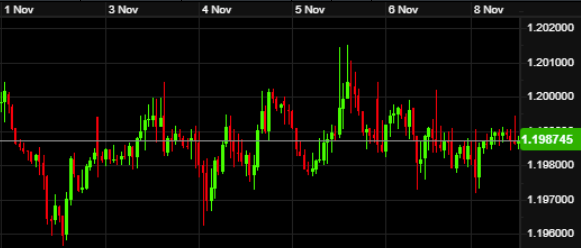
Sterling-Euro saw a flat week with just half a cent’s worth of movement, as illustrated below:
The week ahead:
Monday – Eurogroup & ECOFIN meetings, BoE Bailey speech (17:25)
Tuesday – BoE Breeden speech (08:30), Fed Waller speech (09:00), US CPI inflation (13:30), BoE Pill speech (18:30)
Wednesday – US/CANADA/EUROPE BANK HOLIDAYS
Thursday – UK GDP (07:00), Federal Budget Balance (19:00), ECB Lagarde speech (19:30)
Friday – EU Flash GDP (10:00), US PPI inflation (13:30)
With no more policy decisions for a month from the big three central banks, we are back to other economic data. Sterling has seen a lot of support in the last month from interest rate hike speculation, thus it will be interesting to see if the currency flattens out now the move has been delivered.
From the UK, the main event of this week will then be the release of September’s GDP performance. In this, the economy is projected to flatline for the month, which would be the first lack of growth since April’s data. Aside from this, there are speeches from Andrew Bailey and his Deputy, Sarah Breeden to keep an eye out for.
US news contains both CPI (consumer) and PPI (producer) inflation readings during the week for October. Further rises are expected, especially given the problems Americans are having at the fuel pumps at present. A substantial rise in either or both will further fuel rate hike speculation for a month’s time.
European news will be about Friday’s Flash GDP release for Q3. Will the bloc have expanded by the 0.4% projection, continuing the slow growth trend? Outgoing ECB President, Christine Lagarde, also speaks on Thursday evening.
It is also worth noting the Wednesday is a bank holiday in many countries, for Remembrance Day. This will see markets closed in the US & Canada, as well as some European countries.
There is still plenty for financial markets to digest after last week, thus it will be interesting to see how markets move in the early part of this one. For any required FX conversions across the major currencies, or indeed others, make sure to reach out to the Aston team to discuss in more detail.
Have a great week.
