
ACM Update 08-12-25

Further weak economic data saw the US Dollar lose ground again last week, as GBP-USD moved to a six-week high. The news further increased chances of a Federal Reserve interest rate cut on Wednesday evening. In the UK, the Budget fallout dominated PMQs whilst the Eurozone saw a slight upward revision of growth for Q3.
This week brings the latest US interest rate announcement, followed by more backlogged US jobs data. Midweek speeches from Christine Lagarde and Andrew Bailey will be the focus for European markets, before UK GDP figures for October are published on Friday morning.
It was another troublesome week for Dollar data, as many of the shutdown-delayed releases are now filtering through. Few of these have provided positive news for the world’s biggest economy, as tariff impacts continue to impact the US.
The manufacturing sector was recorded as contracting for the ninth consecutive month in November, according to the latest round of PMI figures. The metric fell to 48.2 for the month, with expansion now having been recorded only four times in the last 48 months.
Jobs data continues to show a slowdown too, including an unexpected drop in private payrolls numbers, from the ADP Non-Farm data. This recorded a drop of -32,000 jobs, where a slight expansion had been projected. Weekly unemployment claims also remained close to a four-year high.
Other employment releases showed weakness too. The job cuts data from firm Challenger, Gray & Christmas, showed layoff announcements had hit 1.1 million for the year to date, the highest figure since the pandemic in 2020. Whilst the monthly figure wasn’t as bad as October, November was still 23.5% up in terms of layoff compared to the same month in 2024.
Core PCE inflation remained constant at a 0.2% monthly increase, showing inflation is not spiraling upwards as some had feared. With weaker data across the board, expectations rose on the likelihood of a Federal Reserve interest rate cut this week. Markets are now pricing an 85% chance of a rate cut on Wednesday evening, at 19:00 UK time.
Speculation on the next Federal Reserve leader is also mounting, as Donald Trump’s economic adviser, Kevin Hassett, seemingly moved into pole position last week. His dovish stance is naturally well-favoured by the President, which would likely lead to further rate cuts from the Fed. This was also Dollar-negative. Trump has for now said he will announce Jerome Powell’s replacement in early 2026.
As mentioned, the Dollar lost ground vs GBP last week, to the tune of 1%. Movements on the pair can be seen in the chart below:
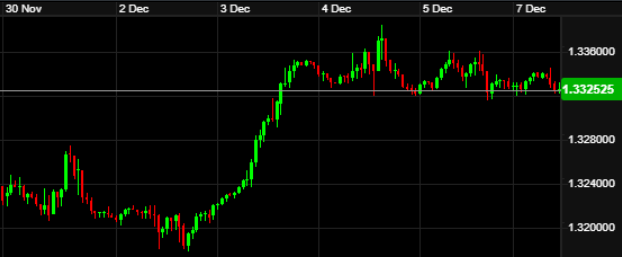
The British Pound benefitted from a slight uplift in sentiment last week, off the back of the Rachel Reeves Budget the week before. This provided fractionally more optimism than had been expected, with concerns of a “Liz Truss mark two” impact proving to be inaccurate.
This didn’t stop the Budget dominating Prime Minister’s Questions in the Commons on Wednesday though, as the fallout from the leaks continued.
Andrew Bailey had a busy week, in front of the Treasury Committee on Wednesday, followed by a press conference in the afternoon. He urged banks to boost lending to help grow the economy, after a recent change in capital regulations. The Bank of England Governor avoided commenting on whether the Budget plan would help growth, but once again raised the importance of increasing the UK’s current sluggish growth rate.
Fellow Bank of England counterparts, Catherine Mann & Swati Dhingra both appeared with Bailey in Westminster. The former also spoke on Friday at an event in Milan, where she maintained her position that the UK isn’t out of the woods yet on inflation. Mann said that price growth still has to be factored in to both household and business spending, and there is still work to be done to get inflation back to the 2% target.
In terms of solid data releases, these were limited. Services PMI data showed expansion, however slower than previously. The Manufacturing PMI figure was identical to the month before. Mortgage approvals were a fraction better than expected at 65,000 in October, albeit slightly down on the previous month.
In the Eurozone, the Flash CPI data for November was published. This produced a slight overshoot of 2.2% versus the 2.1% both forecast and of the month prior. Whilst energy costs across the bloc fell slightly, price growth in the hospitality and services sector was larger than expected.
Of the major European nations, France and Italy (0.8% & 1.1% respectively) were on the lower side of the average, whilst Spain and Germany (3.1% & 2.6%) were on the upper.
Revised GDP figures for Q3 were also published. These showed a quarterly growth of 0.3% for the period, equating to 1.4% annualised. This is slightly down on the annualised 1.6% expansion seen in Q2. The Spanish and French data recorded strong growth of 0.6% & 0.5% respectively in the period, whilst the sluggish German economy flatlined at 0.0%. The better-than-expected overall figure removes any remaining immediate pressure on the ECB to cut rates next week.
Christine Lagarde’s comments last week touched upon the topic of growth. The ECB President spoke in front of the European Parliament’s Committee on Economic and Monetary Affairs on Wednesday. She suggested that monetary policy stability and a resilient jobs market should see the EU benefit from increased household spending.
Lagarde expects EU inflation to “hover around the 2% mandate” in the months ahead. Uncertainties from her side come from the ongoing instability around international trade policies and overall geopolitics. Her colleague Joachim Nagel spoke at two events, reiterating the stance of Lagarde.
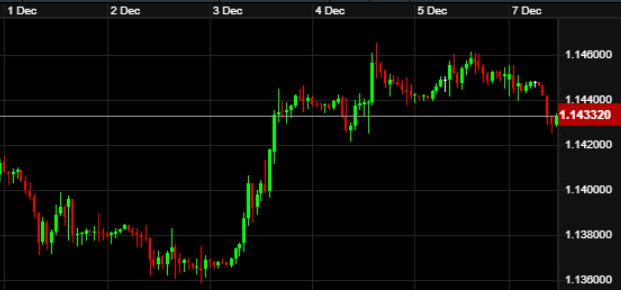
Movements on GBP-EUR can be seen in the chart below, which nudged up to a five-week high in the process:
The week ahead:
Monday – BoE Taylor speech (17:00), BoE Lombardelli speech (18:30)
Tuesday – RBAustralia rate announcement (03:30), US JOLTS Job Openings Sept & Oct (15:00)
Wednesday – ECB Lagarde speech (10:55), BoCanada rate announcement (14:45), Federal Reserve rate announcement (19:00) & Press Conference (19:30)
Thursday – Swiss NB rate announcement (08:30), BoE Bailey speech (10:00), Eurogroup Meetings
Friday – UK GDP & Manufacturing Production (07:00)
With December now in full swing, we approach the final interest rate announcements of 2025 from the major central banks. This kicks off with the Reserve Bank of Australia in the small hours of Tuesday, followed by the Bank of Canada, Federal Reserve and Swiss National Bank later in the week.
For the majority of our clients, the Federal Reserve meeting taking place on Wednesday evening in the UK will be the main focal point. The recent slowdown of the economy in the US, combined with inflation stabilising and constant pressure from the President, are all likely to combine to produce a rate cut. As mentioned already, markets are pricing in circa an 85% chance of a 25 basis point cut.
Further US jobs data also appears on Tuesday, in the form of the JOLTS job openings data from September and October. This will be a preview to the October and November Non-Farm Payrolls data, which will be released as one figure next week.
For UK market news, speeches from Bank of England policymakers are dotted throughout the week. These come from Alan Taylor, Claire Lombardelli and the Bank’s Governor, Andrew Bailey. Friday morning then sees the October UK GDP reading, projected to show 0.1% growth, following a -0.1% drop in September.
In Europe, there are Eurogroup meetings taking place in the week for finance ministers, whilst Christine Lagarde speaks at a Financial Times event on Wednesday morning.
All eyes though will be on the Dollar this week. With further US employment data to come, plus the projected interest rate cut on Wednesday evening, there is potential for further Dollar weakness.
Reach out to the team this week to discuss any currency requirements, and to talk through the different approaches available.
Have a great week.
