
ACM Update 08-06-26

Despite rising inflation, tariff trouble and geopolitical headwinds, the latest US jobs data continues to show resilience. Friday’s Non-Farm Payrolls figure confirmed another bumper month for US employment in May. In Europe, the economy contracted in Q1 as the Iran war hurt supply chains and hit spending.
This week will deliver the latest on US inflation, an almost certain interest rate hike from Thursday’s ECB meeting and April’s UK GDP figure. Geopolitics is also driving markets considerably this morning.
US employment data continues to impress and surprise financial markets in equal measure. Last week’s data from April and May continued that trend and drove Dollar movement on Friday afternoon.
The hawkish Federal Reserve narrative in recent weeks has also been very Dollar-positive. Outgoing Chairman Powell urged Fed independence to remain in a speech to collect a prestigious award on Monday.
Fed Governors also received the publication of the latest Beige Book report on Wednesday evening, outlining the state of the economy ahead of their upcoming rate meeting. The report showed a growing wealth divide, with lower income US families being most impacted by the recent cost of living spikes. Fuel price rises were noted as the biggest contributor.
With the new incoming Fed Governor taking the helm of his first meeting in ten days’ time, we will see if the recent Dollar confidence remains. Kevin Warsh’s first meeting on 17/18th June will likely see debate on whether a Fed interest rate hike will be required, given the resilient employment situation combined with rising inflation.
Peace negotiations in the Middle East continued back and forth, seeing the Dollar whipping around during the week. Early on there was optimism over an extended ceasefire period, but by Friday there were fresh military exchanges between the US & Iran. This saw renewed safe haven flows into the Dollar, boosting the value further.
But the main movement came from the jobs data, primarily that of Friday lunchtime. Earlier in the week both the JOLTS Job Openings for April and ADP Employment Change figures for May both overperformed. The former demonstrated the highest number of openings since October’s data.
Friday’s Non-Farm Payrolls release was truly the blockbuster though. May saw a total of 172,000 jobs added to the US economy, versus a forecast of 85,000. April’s data was also heavily revised upwards to 179,000 additional roles, with March following suit.
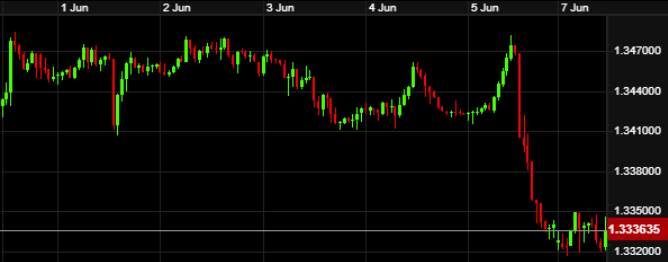
The impact was felt heavily, as the US Dollar surged by 1% in the space of a few hours towards Friday’s close. This took GBP-USD from a weekly high before the data, down to a low dating back to 18th May by the end of the day.
The Dollar’s strength was driven by the fact that strong employment gives the Federal Reserve the flexibility to raise interest rates over the coming months. That in turn led to a major surge in US Treasury yields, which created further demand for the Dollar. The chances of a Fed rate hike in 2026 are currently priced in at 85%.
All in all, a choppy week for the USD with a buoyant Friday afternoon. The Sterling-Dollar chart for last week is shown below:
Whilst GBP saw considerable movement versus the US Dollar, the currency was little moved against the Euro last week. Geopolitical changes in the Middle East impacted the Pound slightly, whilst another week of UK politics staying out of the headlines (relatively speaking) helped too.
Oil prices stabilising undoubtedly offered GBP some stability too. With the UK’s exposure to expensive energy imports, the cooling of such prices was seen as providing some relief to British businesses. One Bank of England survey confirmed that UK firms are growing more optimistic about having to raise prices less aggressively over the next 12 months.
The recent softer UK jobs data though has led to a reduced likelihood of aggressive interest rate hikes to come from the BoE. Steady rates are now priced in for the immediate future, to assist employment. Despite a rate hike looking likely on the continent this week, UK interest rates would still be 1.5% above those in Europe, maintaining a yield advantage and thus attractiveness for the British currency.
We also had speeches from three Bank of England policymakers last week. Andrew Bailey delivered a cautious, patient approach which suggests he is in no rush to raise interest rates immediately. He also rejected the idea that the inflation target should be revised to 3%, suggesting the BoE need to focus “strictly” on getting inflation back to the 2% mandate.
Colleague Megan Greene noted the case for hiking interest rates grows as the conflict in Iran wears on. A potential vote for a rate hike next week from her perhaps?
Swati Dhingra on the other hand spoke of extreme economic uncertainty, whilst refusing to provide any sort of interest rate guidance herself. She simply stated she would support a rate cut if the conflict is resolved rapidly but is open to tightening policy if the geopolitical picture worsens.
Of the little UK data released, Manufacturing PMI figures for May were marginally up. Services figures for the same period also saw a slight uptick. Neither offered much by the way of currency movement.
The major shock in Europe last week was the revision of Q1’s GDP output. This saw the final figure confirmed as a contraction of -0.2% from the 0.1% growth initially recorded. The Eurostat figures suggested the prolonged Iran war and blocked Strait of Hormuz had hurt business sentiment and consumer confidence. The publication of sluggish retail sales figures supported that theory further.
Preliminary data for May also showed that sticky inflation remains a problem in the bloc. The flash estimate recorded 3.2% worth of annual price growth, up from 3.0% in April. With inflation on the rise, markets are pricing in a healthy 95% probability of a quarter-point ECB rate hike when the committee meets this Thursday.
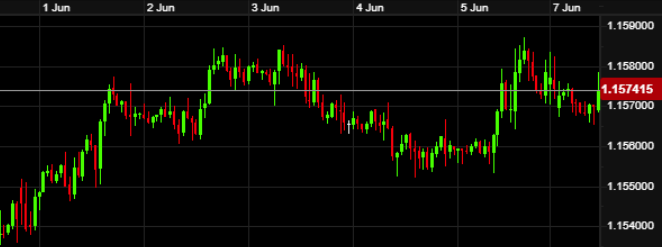
This kept the Euro strong against other currencies, until the US jobs data was published on Friday which saw the single currency sold off. Movements on GBP-EUR last week can be seen below:
The week ahead:
Monday – EU Sentix Investor Confidence (09:30)
Tuesday – UK BRC Retail Sales Monitor (00:01)
Wednesday – US CPI Inflation (13:30), Bank of Canada Rate Announcement (14:45)
Thursday – ECB Rate Announcement (13:15) & Press Conference (13:45)
Friday – UK GDP (07:00), US UoM Consumer Sentiment & Inflation Expectations (15:00)
Yesterday and this morning’s renewal of missile exchanges between Israel & Iran are causing volatility in FX markets as we start the new week. Oil prices have jumped as a result too, with the USD seeing furthers gains. Geopolitics are naturally driving markets again.
In terms of raw data events, the biggest of the week will come from Europe where the ECB meeting starts on Wednesday. The policy announcement itself is released on Thursday lunchtime and is expected to deliver a vote for a 0.25% rate hike. This would be the Bank’s first rate rise since September 2023 and is aimed to help in getting inflation back under control. Given the surprise shrinking of the European economy in Q1 however, the ECB needs to be careful not to suffocate the already sluggish economic growth.
In the US, the main event will be Wednesday lunchtime’s inflation release. Inflation remains persistent in the US and another spike in the reading may ask further questions of the federal Reserve as to their own interest rate rises. The next Fed meeting is less than ten days away.
In the UK, GDP figures for April are published on Friday. Can the British economy keep producing the levels of growth seen in March or was that simply businesses front-loading before the impacts of the war in Iran carried through. Friday at 7am will confirm either way.
Aside from this, geopolitics are now seemingly re-entering the scene. This will add to the uncertainty in currency pricing, especially with the US Dollar. Do get in touch with the Aston team via the usual channels, with any concerns.
Have a great week.
