
ACM Update 01-06-26

With the US & Iran reportedly edging closer to a ceasefire deal once again, oil prices dropped and FX markets were relatively flat. The latest Core PCE data from the US reinforced the “higher for longer” stance expected from the Federal Reserve in 2026.
The start of June brings the latest US jobs data, the Fed’s Beige Book publication and a range of speeches from the Bank of England’s Andrew Bailey. May’s initial Eurozone inflation estimate is also released.
The end of May saw a week largely driven by geopolitical events surrounding Iran. Given the recent yo-yo back and forth on a ceasefire though, foreign exchange markets haven’t been impacted as strongly by such news. But with framework progressing on reopening the Strait of Hormuz, oil prices dropped off heavily as a result.
The oil price drop led to a realigning in expectations for interest rates worldwide, but most of all in the US. With the American market being subject to the biggest war-driven spike in inflation of most major economies, the drop took pressure off the Federal Reserve to raise interest rates aggressively in the short term. This saw the Dollar losing slight value during the week.
But the downward trajectory was not linear. In the middle of the week, the Dollar did regain some ground following fresh US air strikes in Iran. This served as a reminder to markets of the fragile nature of the current talks, and temporarily boosted the safe haven Dollar. Optimism on the talks returned later in the week.
The Fed will be keen to see these talks flowing through to inflation data however. The latest annualised Core PCE figures matched forecasts of 3.3% but remain well above the 2% mandate. This is the highest annual increase in core inflation since late 2023. The monthly change was 0.2%, slightly less than the 0.3% uptick last month.
Released simultaneously was the Preliminary GDP figure for Q1, which projects a 1.6% expansion for the period. This trumps the 0.5% recorded in the final quarter of last year but was down from the initial 2.0% estimate for Q1. Weaker consumer spending was blamed, easily attributable to fears surrounding events in the Middle East.
That said, the latest Consumer Confidence data was also released at 93.1. This showed a slight drop from the (upwardly revised) 93.8 seen in April, but was well above the market forecasts.
Ahead of this week’s Non-Farm Payrolls data, the Dollar remained relatively stable despite geopolitical events. Movements on GBP-USD last week can be seen below:
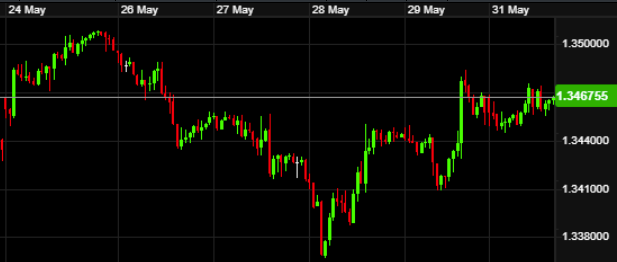
For a second week, GBP benefitted from the battle for 10 Downing Street slipping out of headlines. Fears of a major leadership crisis had been causing nervousness around the currency of late, but UK Gilt yields fell from multi-decade highs once again. As political anxiety surrounding Sir Keir Starmer’s leadership subsided, sterling found support.
Markets remain cautious surrounding recent UK data though. Weak retail sales and sluggish consumer demand both served as a reminder that the UK economic environment remains under pressure, even if the war in the Middle East is seemingly cooling.
GBP was also pegged back by UK interest rate expectations, following speeches from Bank of England policymakers. The most notable of these was Andrew Bailey, who commented that a UK rate hike may not be necessary despite rising energy prices. He believes the Bank may need to let inflation be temporarily above target, in order to safeguard the weak UK economy. He would see a need for action if wage growth begins to spike though.
With the mix of Bank of England caution and weaker data, GBP traded relatively flat across the shorter four day week.
A few Eurozone countries also had bank holidays last Monday too. Beyond that, there wasn’t masses by the way of market data. Inflation continues to remain a concern, highlighted by the preliminary May figures coming in hot for many of the major member states. Spanish figures were up to 3.6%, whilst Italian and French figures recorded 3.3% and 2.8% respectively.
This continues to stem from the supply issues from the Middle East, as well as energy prices soaring from the conflict. The figures point towards stagflation concerns across the bloc and look likely to lead to a rise in European interest rates this month.
On which note, the minutes from the most recent ECB meeting in late April were published, which demonstrated a hawkish tilt. Policymakers debated a rate hike amidst stagflation fears but eventually held rates at 2.0% in a narrowly supported decision.
Many policymakers stated that they would not have opposed an immediate rate hike in the April meeting, had it been explicitly put on the table. Geopolitical and energy price shocks were major discussion points, along with their upward impact on inflation.
Inflation expectations are very much on the rise in Europe still, with ECB President Christine Lagarde stating last week that the committee will be revising their own inflation projections at next week’s meeting.
Currently, markets are pricing in a 91% probability of a 0.25% rate hike next week. This is followed by a projected second hike to come in September.
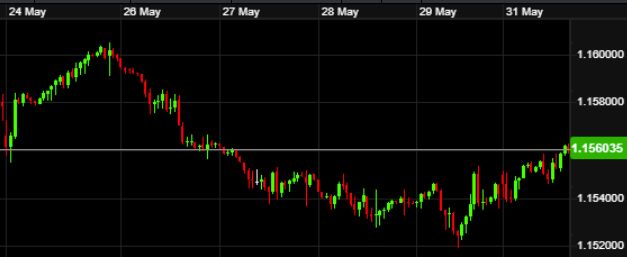
Despite the above, it was a relatively calm week on Sterling-Euro with barely 0.5% worth of movement. The chart for the pair can be seen below:
The week ahead:
Monday – EU/UK/US Manufacturing PMIs (08:15-15:00)
Tuesday – EU CPI inflation (10:00), BoE Bailey speech (15:00), US JOLTS Job Openings (15:00), BoE Greene speech (16:00)
Wednesday – EU/UK/US Services PMIs (08:15-15:00), US ADP Non-Farm Employment Change (13:15), Fed Beige Book (19:00)
Thursday – UK Construction PMI (09:30), US Unemployment Claims (13:30), BoE Bailey speech (16:40)
Friday – US Non-Farm Payrolls & Unemployment Rate (13:30), BoE Dhingra speech (14:40), BoE Bailey speech (19:00)
June starts with the usual flurry of employment data from the US, culminating on Friday with Non-Farm Payrolls. Markets will look closely as to how much, if at all, US hiring is being impacted by the recent cost of living spike and events in the Middle East. A strong print may not be as straightforward as a stronger Dollar though, as the other Unemployment data released simultaneously can often be a mixed bag.
The latest Beige Book publication also appears on Wednesday. This provides the Federal Reserve with the latest market data for their meeting in two weeks, which has the potential to produce a rate hike. Naturally, geopolitical events will remain a strong Dollar driver.
In the UK, aside from the usual monthly PMI data we have a few speeches from Andrew Bailey. The Bank of England Governor speaks on Thursday afternoon and Friday evening, where markets will look for any further hints towards the next policy meeting on 18th June.
Eurozone data is largely PMIs too, with Tuesday morning’s inflation forecast likely to cement an ECB rate hike next week. Watch this space.
FX markets remain difficult to predict due to the ongoing geopolitical climate. Should an extended ceasefire deal be reached, one would expect further Dollar weakness. This outcome keeps yo-yoing back and forth at present though. Do get in touch with the Aston dealing team for any imminent foreign exchange transactions.
Have a great week.
