
ACM Update 02-02-26

The Dollar hit four-year lows last week against the Euro and Pound, as January’s US consumer confidence figures slumped. Donald Trump revealed his long-awaited pick to lead the Federal Reserve, whilst the current committee held American interest rates.
In Europe, growth figures for Q4 were released and GBP continued to enjoy the benefits of some positive data from last week.
February kicks off with the latest interest rate announcements from both the Bank of England and European Central Bank. In the US, the January jobs market data set will be of most importance.
It was a tough end to January for the US Dollar, as the currency experienced significant volatility. A number of factors were at play, both domestic and overseas. As mentioned in the last edition, the week started off with concerns regarding US intervention to support a weakening Japanese Yen. These gradually subsided.
Tuesday however saw poor fundamental economic data published. Consumer confidence hit a 12-year low in January, through widespread concerns about the economy, inflation and a weakening jobs market. The Conference Board’s data showed its worst reading since May 2014 and was well short of estimates.
This continues the slide seen in consumer confidence of late, apart from a slight uplift in December. The portion of the report regarding jobs, suggested new roles were their hardest to obtain since February 2021.
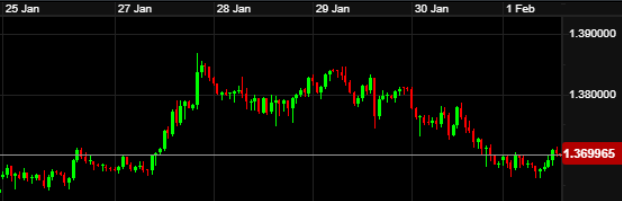
The Dollar was again heavily driven by safe-haven volatility. With US economic nerves, geopolitical tension saw investors move into precious metals such as gold and silver, in the early part of the week. This assisted the Dollar weakening to levels last seen in late 2021 against GBP.
Wednesday evening’s Federal Reserve meeting saw a widely expected hold in interest rates, breaking the recent streak of three cuts in a row. A division on the committee arose though, with two Trump favourites (Stephen Miran & Christopher Waller) calling for another cut.
Chairman Powell’s speech saw him declare the economy on a “firm footing” and “growing at a solid pace”, with seemingly less concern regarding the state of the jobs market than previously. He also spoke of the importance of central bank independence, in eluding to his own legal case and the Supreme Court battle over the potential firing of Fed policymaker Lisa Cook.
One other major takeaway related to the “neutral rate” for policy, that at which the committee doesn’t seek to restrict economic activity. The meeting notes suggested the Fed feel they are closer to this now, which strengthened the Dollar as it suggests less likelihood of cuts.
Later in the week, market nerves in precious metals relating to liquidity saw a move back towards the US Dollar. This combined with Donald Trump revealing his choice for the next Fed leader, as Kevin Warsh, a former policymaker. The nomination was seen as a curious pick, for a man who historically has been an advocate of higher interest rates.
Warsh makes a promise of regime change on the panel, to shrink balance sheets and keep inflation low. His belief is that the AI boom will boost productivity and thus get price rises back under control. The Trump pick must get through a Senate vote first, however.
Other US readings to watch out for going forwards were US factory orders and US producer price inflation. The former suggested that factory orders bounced back by 2.7% in November. On the other side of the coin, producer price inflation rose by 0.5% in the month of December, suggesting more tough times to come for price rises, as these will likely feed through to end consumers.
Overall, it was incredibly volatile for the Dollar last week. The 1.5% range on the pair can be seen below:
On the UK side of things, a quiet week in terms of data. The only release was the mortgage approvals data, which showed the lowest number since July 2024. One would assume that buyers are holding fire in the hope of another interest rate cut to come soon. That or a December lull.
The pound was a beneficiary of the Dollar weakness also in the move up to a 4+ year high. UK business confidence seems to be improving too, as a report last week showed a sharp jump in the reading.
With the lack of data, this week’s Bank of England meeting came into focus. Market expectations of interest rates to stay at their current 3.75% offered further support to GBP. Data released earlier in January showing stronger private sector growth, has moved some forecasts to suggest fewer interest rate cuts to come from the UK in 2026.
The Euro was the major beneficiary of the USD weakness last week. EUR-USD broke through 1.20 for the first time in four and a half years, and at one point went up close to 1.21 on Tuesday evening. We saw range of over 2% on the pair during the week, coming back down after Trump’s Fed nomination to close back in the mid-1.18 range.
A strong Euro isn’t always the best news though, as was voiced last week from various corners. The bloc’s export-driven economy tends to be hampered by higher interest rates, thus a fall back versus the Dollar later in the week was likely welcomed.
Of the data releases, unemployment in the bloc was recorded as 6.2% for December, back down to July lows. The continent continues to enjoy lower unemployment than historically so.
Growth looks to be more of a mix across the continent, but all of the major players grew at least in Q4, as a part of 0.3% expansion for the Eurozone as a whole. Spain and Portugal continued to perform well both with 0.8% growth for the period, whilst Germany and Italy recorded 0.3%. France was slightly behind at 0.2%, whilst Ireland was the only member nation to contract, shrinking by -0.6%.
Another positive step was the EU-India trade deal announced last week, designed to reduce dependence on the US amid ongoing tariff threats. This too provided a short-term boost for the Euro.
In speeches spread across the week, rate-setter Joachim Nagel suggested “rate stability” is required from the ECB in echoing the bank’s Chief Economist, Philip Lane. Nagel sees no reason for a change in either direction in monetary policy for now. This comes ahead of the latest ECB meeting this Thursday.
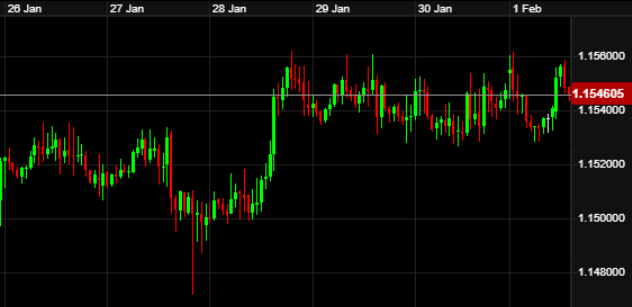
Another volatile week for the Euro versus the Dollar, but less so vs GBP as per the chart below:
The week ahead:
Monday – EU/UK/US Manufacturing PMIs (08:15-15:00), BoE Breeden speech (11:45)
Tuesday – RB of Australia rate announcement (03:30), US JOLTS Job Openings (15:00),
Wednesday – EU/UK/US Services PMIs (08:15-15:00), EU CPI Flash Estimate (10:00), US ADP Employment Change (13:15), Fed Cook speech (23:30)
Thursday – EU Retail Sales (10:00), BoE rate announcement (12:00), BoE Bailey press conference (12:30), ECB rate announcement (13:15), ECB Lagarde press conference (13:45)
Friday – BoE Pill speech (12:00), US Non-Farm Payrolls & Unemployment Rate (13:30)
Into February and there is something to focus on in terms of fundamental economic data from the UK, US and Europe this week. Aside from the usual releases of the latest PMI figures, demonstrating growth or contraction in the Manufacturing & Services sectors, most of the significant events are in the latter part of the week.
The Bank of England lead off a busy Thursday lunchtime with their latest interest rate announcement. Expectations of a February cut were quickly cooled by a bounce back up in the latest inflation reading, therefore a hold in policy seems likely here. This meeting is projected as a 7-2 for a hold. A March cut seems the more plausible option now, so any hints on that would be welcomed.
The ECB are then next up merely an hour later, for their own rate decision. Frankfurt looks almost certain to make it five policy holds in a row, with Eurozone inflation under control and growth slowly improving. The question will be more if, rather than when, they cut again this year.
Friday will see the culmination of the start of the month raft of US jobs data releases. Given the commentary from various sources that the US jobs market is in a tough place at present, another low Non-Farm Payrolls figure is projected. Will a further slowdown in these readings lead markets to expect a rate cut in the next Federal Reserve meeting on 18th March?
We saw plenty of volatility last week and given the significant events this week, one can likely expect the same. To discuss pending requirements, make sure to reach out to the team. Limit orders are proving popular at present given the movement, as well as forward contracts to secure longer-term requirements. Get in touch for more information.
Have a great week.
