
ACM Update 27-07-26
Renewed hostilities in the Middle East, a return to tariffs and a new UK Prime Minister were all major market drivers last week. We also saw UK inflation softening in June, as well as a widely expected hold of interest rates in the latest ECB meeting.
This week sees significant interest rate announcements from the Federal Reserve and the Bank of England on Wednesday and Thursday respectively. These will be joined by inflation data from the US and Eurozone, as July draws to a close.
Renewed hostilities in the Middle East saw the US Dollar regain ground last week. A further series of strikes from both sides saw oil prices rise, as well as the Dollar Index (DXY) rally to a one-month high. Further threats of blockades in the Strait of Hormuz saw delays for energy tankers in the region. The last two nights have seen a pause for further talks though with oil dropping accordingly this morning, having gained around 10% last week.
As is usually the case, the USD gained ground as the conflict reignited in the Gulf. The safe haven status of the Dollar saw it gain around 1% in the week. This is less movement than at the beginning of the conflict, as markets gradually adjust and get used to such changes.
Late on in the week, we saw the latest blanket tariff rollout from Donald Trump. With the latest percentages expiring, the President opted to roll out duties of up to 12.5% on sixty global economies which account for 99.4% of US imports. Cue immediate counter lawsuits and likely retaliatory tariffs from other countries.
The changes came in given the previous decision from the Supreme Court that “Liberation Day” tariffs were illegal. Federal Reserve analysts estimate that the previous round of tariffs raised the price of core goods for Americans by 3.1%.
Domestically, US data offered resilience. Initial jobless claims numbers dropped unexpectedly to 187,000 for the week. This was the lowest reading since 1969 and continues to show how robust the employment sector is, despite the weight of tariffs and other geopolitical factors.
PMI data for business activity in the private sector grew at the fastest pace of the year so far, to underline the confidence levels. US Treasury yields meanwhile saw a spike to 4.71%, the highest since January 2025, which further boosted the Dollar’s yield advantage.
This week brings the latest Federal Reserve meeting, with the usual announcement and press conference on Wednesday evening (19:00 & 19:30 UK, respectively). Despite the mix of recent data, a policy hold is still expected, with only a 30% chance seen for a hike.
But a September rate increase is now priced in at an 82% probability. Part of this mindset is that stubborn energy costs, especially in light of the Middle East re-escalation, are providing concern that inflation may remain stuck well above the 2% Federal Reserve target.
Further uncertainty comes from the removal of forward guidance (future rate expectations) from new Fed Chair, Kevin Warsh. His heavily reduced statements are keeping markets guessing, making this one of the most unpredictable rate announcements for some time.
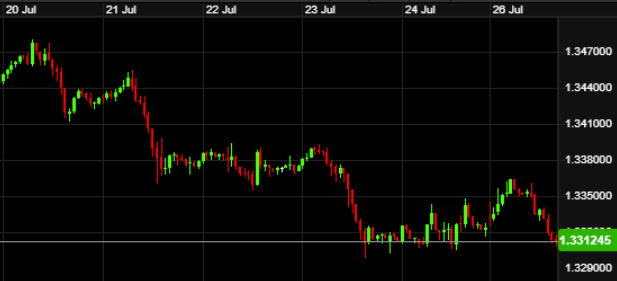
Movements on GBP-USD last week can be seen in the chart below:
In the UK, Andy Burnham officially took over as Prime Minister last week. He moved to establish his “cost of living Government” in cutting electricity VAT, dropping business rates for some sectors and capping bus fares. The PM established “Number 10 North” and also reshuffled his cabinet, removing key Starmer allies from their posts.
Most notably, Burnham replaced Rachel Reeves with a new Chancellor, John Healey. Markets viewed this appointment with cautious reassurance, seeing him as a “safe pair of hands” who committed himself to fiscal rules. The new PM’s aggressive spending agenda, however, has led to rising financial skepticism and some concern in the bond markets. Healey will need to both balance the books and deliver economic growth, a double act his predecessor struggled with.
There was good news about the cost of living by the way of inflation data last week. The publication of the June figure saw headline CPI fall to 2.6% for the month. This was down from the 2.8% seen in May and below the 2.7% market estimate. A lull in the Iran conflict in the month saw a fuel price dip, which heavily assisted the drop.
The data saw expectations for aggressive interest rate hikes to come from the Bank of England, very much dampened. The current pricing for a hike in this Thursday’s meeting is now around 20% probability. GBP weakened against the EUR and USD as a result in the middle of the week.
We also saw some resilient UK data published. Retail sales demonstrated a 1.0% monthly expansion in June, likely driven by the fine weather and World Cup-related spending. The figure was well above the -0.3% contraction forecast. Flash PMI preliminary data also rebounded in the month. All of the above compounded the likelihood of interest rates remaining as they are at this week’s Bank meeting.
On the continent, the European Central Bank opted to leave interest rates unchanged in their July meeting. Lagarde & Co maintained their data-dependent stance but noted a September rate hike is looking increasingly likely due to energy price risks. The ECB’s own economists also see a slowdown in growth for the bloc, thus opted to revise the 2026 economic growth projection to just 0.8%.
The Euro also lost ground on the other side of the Dollar strength from the Iran conflict. Being heavily exposed to imported energy, the single currency will remain vulnerable to inflationary concerns the longer the conflict continues.
The renewed US push on tariffs is also causing further uncertainty on the continent. Trans-Atlantic trade is likely to be heavily impacted by these changes, at a time when European growth is already under pressure. Major contributors such as Volkswagen are facing worries about weak exports and a major drop in sales in China.
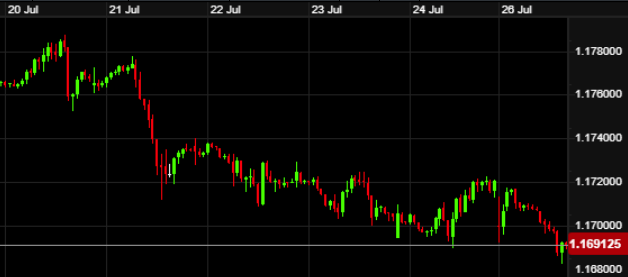
The Euro regained slight ground versus GBP last week, moving back from recent highs. Movements on the pair can be seen in the chart below:
The week ahead:
Monday – US Durable Goods (13:30)
Tuesday – US Consumer Confidence (15:00)
Wednesday – Aus CPI Inflation (02:30), Fed Rate Announcement (19:00) & Press Conference (19:30)
Thursday – EU Flash GDP (10:00), BoE Rate Announcement (12:00), US Advance GDP & Core PCE (13:30)
Friday – BoJ Rate Announcement (03:00), EU CPI Flash Estimate (10:00), BoE Pill speech (12:15), US Consumer Sentiment & Inflation Expectations (15:00)
The last week of July has a few significant announcements taking place, primarily those relating to interest rates. Wednesday evening sees the latest US interest rate decision, which is forecast to be a hold in policy. As mentioned though, the lack of forward guidance from new Fed Chair, Kevin Warsh, makes the decision less clear cut than was the case under his predecessor. The press conference after may offer some more clues.
Other significant US data releases are scattered throughout the week, with consumer confidence and inflationary data also published. The Advance GDP release will also be crucial to demonstrate the level of economic output in Q2, a time where the US was also fighting the Iran war.
The Bank of England are also in the spotlight with a policy decision on Thursday. With softening inflation and recent positive retail sales data, we expect to see no change again on Threadneedle Street. This is likely to offer little by the way of support to GBP.
Given the ECB’s rate announcement last week, all is relatively quiet on the continent. Flash GDP estimates for Q2 in the bloc seem to suggest 0.2% worth of growth for the period, reversing the same negative figure in Q1. July’s CPI inflation meanwhile is expected to nudge to 2.9% for the month, up from 2.8% in June.
With geopolitics back in the frame once again, we could quite easily see further USD volatility to come. Oil prices are again bouncing around wildly, driven by the conflict also.
Given the factors at play, make sure to reach out to the Aston team to discuss and secure any pending requirements you may have.
Have a great week.
