
ACM Update 10-08-26
July turned out to be a poor month for US employment figures, one of several bad news headlines for Donald Trump last week. The President’s administration had to pay back $100bn of his now infamous “Liberation Day” tariffs. On the continent, the EU saw a slight improvement in recent data.
This week sees the latest US CPI & PPI inflation as well as Retail Sales data published for July. In the UK, GDP for June is released but another month of negative growth is expected.
With a quieter period and lower market volumes during August, US data was the focal point last week. But what was published wasn’t great news for the Dollar or the US economy itself, as the July employment data recorded a hefty miss. Previous months also saw downward revisions.
Despite some recent optimism about the state of the US jobs market, the figures are now beginning to display a declining trend. July proved to be well short of market forecasts, with the economy losing 23,000 jobs in the period. Predictions were in and around the 80,000 level for jobs to have been added, thus this was a considerable flop.
Most losses came at local government level, whilst retail and financial activities lost over 30,000 jobs combined. Healthcare, construction and manufacturing recorded some growth, but not enough to sway the balance.
Perhaps most importantly, both the May and June figures were also revised heavily downwards by a combined total of over 103,000 jobs. Interestingly, June and July combined, the period in which the US held the majority of the World Cup, still saw a net drop. Unemployment as a percentage did drop to 4.1% but this was more due to over a quarter of a million people exiting the workforce altogether.
The disappointing jobs results saw a sharp sell-off in the Dollar on Friday afternoon. The knock-on effect on future interest rates was a fall in expectations of a Federal Reserve rate hike in September, as the sluggish results take such pressure off the policy committee.
On the geopolitical side, the Dollar also faced weakness. Further de-escalation optimism in the Middle East saw safe haven appetite reduce accordingly. As is evident recently though, news on this topic moves back and forth regularly and at pace.
Positive Q2 corporate earnings data from the US helped boost US stocks, which meant less appetite for the Dollar. The currency intervention on the JPY was also a short-term factor.
As mentioned in the introduction, Donald Trump’s wallet, or at least that of the Trump administration, endured an expensive few days. They were forced to pay back $100bn of his Liberation Day tariffs via Customs officials. That equates to roughly 60% of those accrued under the scheme.
A major German energy company also accepted a settlement of $1.2bn from Trump’s Department of the Interior. Trump is a well-known critic of the “ugly turbines” used in wind farms, so sought to terminate the contract.
All in all, a tough week for the President and the US currency. GBP-USD moved up to a three-week high on Friday, as per the chart below:
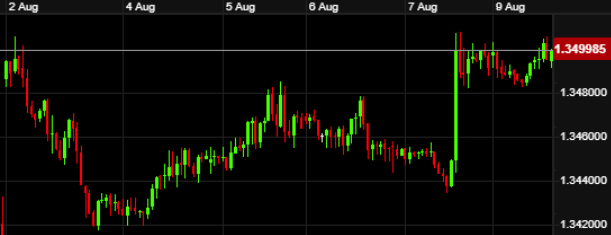
What was bad for the Dollar, was good for the Pound undoubtedly on Friday afternoon. Given the similar interest rate levels between the two currencies, GBP saw a slight lift off the back of the disappointing US data, with markets viewing it as a viable alternative for yield.
The results from the previous week’s Bank of England meeting were also still being digested by financial markets. The 6-3 vote split was one more vote for a hike than forecast, leading to a lingering sentiment that an upward rate move may be a possibility before the year is out.
Other UK data was limited. The latest Lloyds house price index showed no change at all between June & July, whilst construction data for the latter exceeded estimates. Services sector results were marginally better than forecast, whilst manufacturing was under expectation. The services sector being the largest offered some slight support.
This week brings UK GDP for June, forecast as a -0.1% month-on-month contraction. The week after will bring the July inflation results. GBP will need that hawkish feel from the Bank of England to hold for any major upside, as well as inflation and GDP to go the right way.
The Euro meanwhile enjoyed a strong week, further boosted by the negative US data on Friday afternoon. Recent Eurozone data has looked slightly better, especially with 0.4% worth of quarterly growth in the preliminary Q2 figures. This marks the best quarter since Q1 2025.
Business activity figures in July from S&P bounced back to an eight-month high of 52.0, leaning towards a positive expansion for the bloc at the start of Q3. After weaker results last week, the German economy also saw factory orders surge 3.1% in June, considerably ahead of projections.
With upward pressure on European inflation, markets have had to realign their interest rate expectations for the coming policy meetings. The CPI move up to 2.9% in July was primarily fuelled (excuse the pun) by a 10% rise in energy prices in the month.
The data combined with hawkish narrative from some ECB policymakers has now increased the probability of an interest rate hike to come in September. Markets are currently pricing in one additional hike by the end of the year.
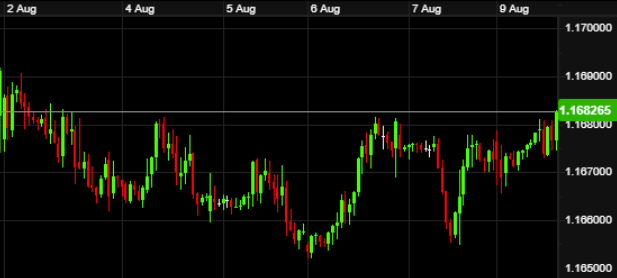
A good week for the Euro against the Dollar, but very much status quo for GBP-EUR over the same period. Movements on the latter can be seen in the chart below:
The week ahead:
Monday – EU Investor Confidence (09:30)
Tuesday – Reserve Bank of Australia rate decision (05:30)
Wednesday – US CPI & Core CPI inflation (13:30), Federal Budget Balance (19:00)
Thursday – UK GDP (07:00), US PPI & Core PPI inflation (13:30),
Friday – EU Flash GDP Q2 (10:00), US Retail Sales (13:30), US Consumer Sentiment & Inflation Expectations (15:00)
US and UK data releases will share the economic limelight this week. The two US inflation releases for the Dollar could be crucial in indicating which way interest rates might go in the September Federal Reserve meeting. Estimates predict July’s CPI to have ticked downwards to 2.5%, but an upward deviance could put a rate hike back in the picture. The question would be whether Warsh & Co would prioritise reducing inflation or supporting jobs. Recent comments would suggest the latter.
We also have the latest Federal Budget Balance figure on Wednesday evening. This displays just how much of a financial pickle the US is currently in.
UK GDP for June is not expected to have been boosted by barbeque or World Cup fever. The reading is projected as a -0.1% contraction as the economy continues to demonstrate mediocre output levels. As above, the Pound will need some positivity from this data to maintain the recent upward trend.
Aside from the above, the only other major event is Tuesday morning’s interest rate announcement from the Reserve Bank of Australia. This should be a hold in interest rates, marking the second hold in a row following three consecutive hikes in the first half of the year.
As always, quieter market conditions don’t always mean less movement. In fact, the opposite can usually be said. For an upcoming currency conversions or pending payments, get in touch with the Aston team via the usual channels.
Have a great week.
