
ACM Update 09-03-26

Events in the Middle East were the major driver of foreign exchange markets last week, as military strikes on Iran dominated headlines. The latest US jobs market figures saw a further slump for Trump, whilst the UK spring statement saw a downgrade to this year’s growth forecast. GBP-USD slipped to a three-month low.
The week ahead brings the latest on US inflation, as well as both UK & US GDP numbers. Geopolitics will remain the major driving force though.
The US Dollar saw major gains last week, up to 2% to the good at one point versus both the Euro and British Pound. The US/Israeli military action in Iran was the main reason behind this, as market investors sought out the safe-haven status of the US currency, boosting its value. Whilst the Dollar gained from this initially, US data releases and inflation concerns as a direct impact of the conflict, saw the currency to yo-yo back and forth.
On one side, oil price fears stemming from disruptions in the Strait of Hormuz where 20% of global oil flows through, saw the likelihood of higher inflation and less chance of US rate cuts to come. On the other, the US jobs market data continues to weaken which in theory would move the Federal Reserve more towards rate cuts. This drove considerable USD volatility.
The full set of February employment data was particularly poor for the US economy. Headline unemployment moved up to 4.4%, with further drops in manufacturing. But there were also falls in construction, leisure & hospitality, all impacted by severe winter storms in the month.
The main event of Non-Farm Payrolls saw a decrease in US jobs of -92,000 versus a forecast rise of around 50,000. This marked the second-largest decline in the last 14 months. December and January figures were also revised down by a combined 69,000 jobs, where December’s gain was in fact flipped to a loss.
The likelihood of rising inflation as a result of the Iran conflict, combined with a slowing jobs market, will cause major headaches for the Federal Reserve. Being two weeks prior to the next Fed meeting (18th March), the Beige Book was published to contain the decision-making data at the committee’s disposal.
Some areas recorded “slight to moderate” economic growth, but an increasing number saw growth as flat. The latest tariff debacle had been highlighted in many states as a cost concern, with employment still a headache. What the Fed will decide next week though may well be more driven by the ongoing developments in the Middle East.
Movements on GBP-USD last week can be seen in the chart below:
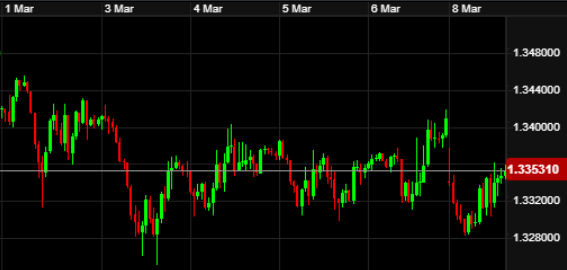
UK monetary policy was also impacted by the knock-on effects of events in Iran last week. With oil and energy prices rising, inflation expectations were also revised. This meant the possibility of a Bank of England rate cut next Thursday was slashed from 75% to around 25% by financial markets. The change saw some GBP weakness midweek, as fears of stagflation returned.
The other side of the stagflation puzzle rests in economic growth. The topic emerged in Chancellor Rachel Reeves’ spring statement in the House of Commons on Tuesday, where she focused on “cautious stability” rather than rocking the boat with tax changes.
Unfortunately, the Chancellor also had to declare that the OBR (Office for Budget Responsibility) had downgraded their UK growth forecast for 2026 to 1.1%, from the 1.4% projected back in November. This was based on weaker than expected UK data from the back part of last year. The forecast for the following two years is 1.6%. Inflation is forecast to average 2.3% this year, returning to the 2% target in 2027. Naturally though, recent news events could derail this.
Public finances were declared as in slightly better shape, with increased fiscal headroom now at £24bn, the highest since November 2022. Compared to the autumn budget, public sector borrowing is forecast to be £18bn lower, as well as debt interest costs coming down. Despite not making many headlines, this offered support to GBP.
In terms of published data, the trio of manufacturing, services and construction PMI releases were all disappointing for February. The latter was the worst of these, as a decline in housing activity weighed heavily on the sector, having shown positivity the previous month.
In Europe, geopolitics were also key to the fortunes of the currency. With the US and Euro the two major forces, often what is good for one is bad for the other. This proved true last week, as those seeking a safe haven moved from the Euro to the Dollar, weakening the single currency in the early part of the week.
However, the sensitivity of the Euro to energy price changes led to a dramatic shift in the possibility of interest rate changes to come from the ECB. Two weeks ago, markets priced the chances of an interest rate CUT this year at around 50:50. But following events in the Middle East, that has now flipped to a 65% likelihood of a rate HIKE, to see off an increase in inflation.
Recent data releases for the bloc showed inflation was already running slightly higher than thought in February. The 1.7% of the previous month was calculated as 1.9% for month, admittedly still under the mandated target.
GDP growth meanwhile for Q4 was unexpectedly revised by a decimal lower to 0.2%. On the retail sales front, whilst the January figure saw a -0.1% drop, the December figure was revised to a positive at least of 0.1%.
The other release was that of the ECB Minutes from their early February meeting. This showed all policymakers in agreement to keep rates unchanged, feeling their current stance remained the most appropriate. The “data-dependent, meeting by meeting” line continues. Concerns were raised about tariff and geopolitical uncertainty though, both of which have developed significantly since then.
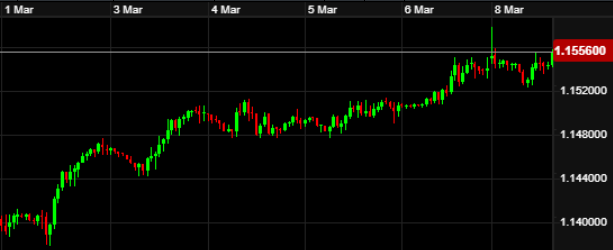
Overall, GBP-EUR nudged up to its highest in a month, with movements last week in the chart below:
The week ahead:
Monday – US & Canada DST Change, Eurogroup Meetings, G7 Finance Meetings
Tuesday – ECOFIN Meetings
Wednesday – US CPI inflation (12:30), Federal Budget Balance (18:00)
Thursday – BoE Bailey speech (09:30), US Unemployment Claims (12:30)
Friday – UK GDP (07:00), US Core PCE inflation & Prelim GDP (12:30), US JOLTS Job Openings (14:00)
A brief note that with clocks having gone forwards in North America at the weekend, US trading events are an hour earlier than they normally would be.
For this week, geopolitics will remain the major driver of FX markets. Times of uncertainty will always lead to the US Dollar strengthening, with the oil price situation also being a factor. How this will impact inflation forecasts for the major currencies will also be important to determine their ongoing trends.
Market data is likely to play second fiddle, but the major releases this week ae spread over the second half. From the US, the February inflation reading arrives on Wednesday lunchtime and is predicted to show a slight uptick to 2.5% in the month. Further inflationary info arrives from Friday lunchtime’s Core PCE reading, which is released in tandem with the Q4 Preliminary GDP number. This is expected to have confirmed a slowing to 1.4% for the period. The JOLTS Job Openings figure closes the week on Friday, slightly delayed after the recent shutdown.
UK data will mainly be geared around the January GDP reading, which arrives first thing on Friday morning. This projects 0.2% growth, to follow up the 0.1% seen in December. Andrew Bailey also speaks on Thursday morning on a Financial Stability Board summit, just a week prior to the next Bank of England meeting.
Eurozone news is relatively thin, apart from European and G7 Finance meetings in the first part of the week.
The current geopolitical picture is making market movements more challenging to predict than ever. As such, reducing FX risk and exposure is key, so make sure to get in touch with the Aston team throughout the week. There are various approaches, dependent on individual situations.
Have a great week.
