
ACM Update 03-03-26

The final week of February saw the latest implementation of US tariffs, as well as a lengthy State of the Union address by Donald Trump. The ongoing geopolitical events in the Middle East are driving FX markets this week, with the safe haven US Dollar the main mover.
The main economic events this week will be the UK Chancellor’s Spring Statement on Tuesday lunchtime and the latest US jobs data for February, published on Friday. These are likely to play second fiddle though to the rapidly-changing geopolitical picture.
Whilst it was an unprecedented end to February in terms of news events over the weekend, there were other notable points too. Tuesday was the main event in many ways, economically, politically and for international trade.
Starting off on the trade front, Trump’s revised set of tariffs kicked in at 10% on the 24th February, lower than the 15% he had threatened. Following the Supreme Court ruling a few days before, the Dollar started the week on the back foot as uncertainty prevailed.
The President spent his evening in Washington, delivering as expected a theatrical and combative State of the Union address, boasting about his economic successes of the last 12 months. The patriotic speech lasted 107 minutes, the longest on record. Whilst berating many members of his audience, he somehow only managed to use the word tariff a mere four times.
As always, the President was full of confidence in declaring a “turnaround for the ages”, which was backed up by the latest Consumer Confidence data, also released on Tuesday afternoon. Despite slowing growth, this saw a marked improvement on the previous month, rising to 91.2 and the best figure since October.
One release of note for the Federal Reserve will be the latest PPI (Producer Price Index) inflation figure. This saw a January rise of 0.5% month on month, exceeding expectations. The overshoot suggests inflation remains stubborn, adding fractional uncertainty to future rate cuts.
Other US data remained positive though, as the latest weekly Unemployment Claims release remained lower than has been the norm of late. The Supreme Court ruling weighed heavily on the currency until the latter part of the week though, before geopolitics returned to dominate.
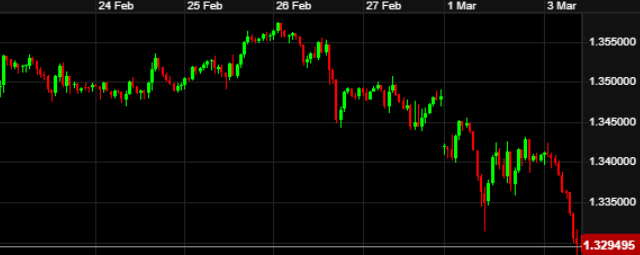
The potential of escalation in the Middle East saw a strengthening US Dollar on Thursday and Friday, gaining around 1% versus GBP for example. This has been further compounded over the weekend, as markets opened up on Sunday night with investors flocking to the Dollar, given USD’s safe haven status. This continued yesterday and took Sterling-Dollar to a 10-week low as of this morning.
Movements on GBP-USD can be seen in the chart below, including the shift in early trading after the weekend:
UK data events were few and far between, which didn’t help the currency particularly. The undertones of political uncertainty and the recent softer inflation data weighed heavily on GBP during the week. An unexpected by-election loss for Labour to the Greens in Gorton & Denton, saw leadership speculation and more embarrassment for Keir Starmer.
Economically the main events were from Bank of England policymakers who delivered a triple header of different opinions. On the cut side of the equation was Alan Taylor, who predicted as many as three interest rate cuts to come in 2026. Taylor suggested the outlook for the jobs market was too pessimistic and he is more worried about undershooting the 2% inflation target.
On the other side of the fence, Chief Economist Huw Pill. He delivered his constant message of caution, commenting the disinflation process is “still incomplete”. Pill’s recent comments have been that interest rates are already too low.
In the middle ground and keeping his cards close to his chest was Andrew Bailey. The Bank of England Governor believes the March rate decision is a “genuinely open question”. This indecision was GBP-negative, given how many times lately that Bailey has held the casting vote in a 5-4 split.
Over in Europe, the currency maintained a relatively neutral position throughout the week, staying in the mid-1.14s versus GBP and around 1.18 against the US Dollar. That is, before the weekend’s events. Given European reliance on US trade, FX markets were very much in wait and see mode around future tariffs. European equity markets meanwhile reached all-time highs.
German data provided some support to the single currency, as German business confidence figures outperformed. A comeback from the continent’s biggest contributor would really help boost overall figures for the bloc. For now though, continent-wide business confidence dropped off in February. Consumer confidence meanwhile showed improvement.
Looking at the next ECB meeting on 19th March, the February inflation figure for Europe was confirmed as 1.7%, slightly under the 2% target still. A Christine Lagarde speech on Thursday suggested that whilst inflation was down, “perceived inflation” remains higher which is complicating future policy decisions.
Despite speaking at two events during the week, these were pretty much rinse and repeat press conferences from President Lagarde. The ECB will maintain their data dependent, meeting by meeting approach, whilst inflation is expected to stabilise at 2% in the medium term. Nothing new for markets to digest there.
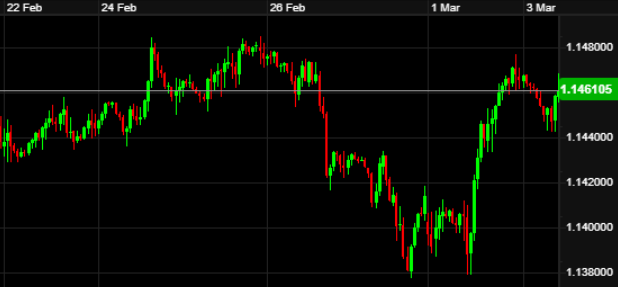
GBP-EUR was little moved for most of the week, until domestic politics saw the Pound weaken towards the weekend. Movements are shown below:
The week ahead:
Monday – EU/UK/US Manufacturing PMIs (08:15-15:00), ECB Lagarde speech (14:00), BoE Ramsden speech (15:30)
Tuesday – EU Flash CPI inflation (10:00), UK Spring Budget (12:30)
Wednesday – EU/UK/US Services PMIs (08:15-15:00), US ADP Employment Change (13:15), Fed Beige Book (19:00)
Thursday – EU Retail Sales (10:00), ECB Minutes (12:30), US Weekly Unemployment Claims (13:30), ECB Lagarde speech (17:00)
Friday – EU Revised GDP (10:00), US Unemployment & Non-Farm Payrolls (13:30)
Naturally, events in the Middle East have caused volatility in FX markets since the weekend. These will remain the major driver this week. The US Dollar has gained circa 1% against GBP and the Euro yesterday morning, amid widespread concerns about the rapidly developing geopolitical situation. That movement has continued today.
There are two notable economic events this week also, from the UK & US. Tuesday lunchtime sees the Spring Budget statement, delivered by UK Chancellor Rachel Reeves in the House of Commons. Whilst not a guaranteed market mover, much depends on the content. Hopefully for Reeves it isn’t published before she stands up to deliver it, this time around.
The main data event of the week therefore will be on Friday afternoon, when the latest US Unemployment and Non-Farm Payrolls figures will be published. Unemployment for February is expected to remain at 4.3%, whilst NFP (measuring jobs added to the economy) is projected a modest month of 58,000 extra jobs. This would be down from January’s surprise overshoot of 130,000.
As mentioned though, geopolitical events will be the big driver this week, making exchange rates even more unpredictable. For any pending requirements, make sure to reach out to the Aston team to discuss in more detail the best way to protect your exposures.
Have a great week.
