
ACM Update 15-06-26
The US Dollar was again heavily driven by the conflict between the US & Iran last week, as tensions escalated before the long-awaited deal was reached late yesterday. In Europe, the ECB delivered a much-expected rate hike, whilst the UK economy contracted in April.
The coming five days will deliver a plethora of central bank meetings. These include the Bank of Japan on Tuesday, Kevin Warsh’s first Federal Reserve meeting on Wednesday and the Bank of England on Thursday. UK inflation figures are also published.
We start off again with geopolitics, which were again a major driver of financial markets last week. This was most notable on the safe haven driven USD, which moved over 1% in the week. Tensions rose again between the US & Iran after the shooting down of an Apache helicopter in the region, but this morning there seems to be progress.
President Trump has announced “The Deal with the Islamic Republic of Iran is now complete” whilst the Iranian Foreign Minister has declared the same on state TV. Both parties are to sign the official agreement this Friday in Switzerland.
Initial market reaction has been a sell-off of the US Dollar, with the currency seemingly less attractive now as a safe haven. Oil prices have also fallen back to their lowest levels since early March, as the Strait of Hormuz has been declared as reopened by both sides. That will inevitably take some time to happen fully though.
The news will be of great relief globally, especially following a World Bank report last week stating the war had “damaged two-thirds of the world’s economies”. The report also lowered the global growth forecast to 2.5% for 2026, the lowest projection since the recession during the Covid pandemic.
The news comes at a crucial time, with the latest inflation figures from the US showing a 4.2% annual increase in the cost of living (CPI inflation). Monthly price rises slowed slightly to 0.5% in May, following upticks of 0.9% & 0.6% in March & April respectively. Trump meanwhile declared he “loves the inflation” and that he would make it “fall like a rock” as soon as the combat was over. We shall now see if that happens. Proof, pudding, etc.
The May figures also proved that inflation isn’t spiralling in the US. Both the Core CPI and PPI figures were slightly softer than expected, thus reducing the need for aggressive Federal Reserve rate hikes. This limited Dollar upside strength.
Despite the Iran peace deal and less concerns about inflation, the Dollar found strength from the recent beneficial employment data. This is offering some support to the currency as a strong jobs position leaves the Fed highly unlikely to cut interest rates in the short term.
On which note, all eyes will now be on this week’s Federal Reserve meeting, with the announcement on Wednesday evening. This is unlikely to see a change in policy given the recent peace agreement, but Kevin Warsh’s first meeting at the helm makes it a slight unknown.
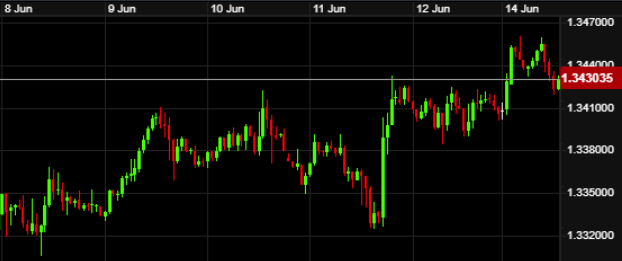
The upward movement on GBP-USD over the last week can be seen below:
European news was dominated by the ECB’s first rate hike in three years, aimed to deal with their own war-driven inflation issues. The Bank moved to increase interest rates by 0.25% as widely predicted for a few weeks now.
However, it was the changing of their own forecasts that was most significant from Frankfurt. The 2026 baseline inflation projection was ramped up to 3.0%, from 2.6% in the last meeting. Domestic price growth thus remains a major threat in the bloc, but also means we are likely to further rate hikes this year. This boosted the strength of the Euro accordingly, especially versus the sold off Dollar.
On the other side of the coin, the ECB also had to move to cut their growth forecast for the year. This now sits at 0.8% with concerns about stagflation (stagnant growth and stubborn inflation) swirling again.
Christine Lagarde’s press conference stated that the delivered hike was “necessary, not an insurance move”. The President also declared that war-driven inflation shocks were continuing to broaden across the Eurozone, with energy cost spikes impaction food, manufacturing costs and consumer services.
She also reported an incredibly resilient employment market, which is helping the overall picture. Lagarde reaffirmed that the committee remained highly data-dependent in their meeting-by-meeting approach. This continues to be their strict stance.
In the UK, Sir Keir Starmer faced further political headwinds. The UK Defence Secretary, John Healey, was the latest in a long line of recent cabinet resignations. He was promptly followed by the Armed Forces Minister resigning, both of which exposed deep fiscal divisions. Starmer continued to state he “must turn things around” despite the renewed threat of a leadership challenge.
Despite all of the euphoria from Number 10 surrounding the Q1 growth data, it was back down to earth with a bump again for Starmer & Reeves. April saw a contraction of -0.1% in domestic output for the month, largely driven by the crucial services sector. This forms the majority of the economy and shrank by -0.2% in the month.
Most business being directly or indirectly impacted by oil price rises, stemming from the closure of the Strait or Hormuz. This led to increasing costs and thus a slowdown in transport, wholesale and accommodation costs. Many consumers had also front-loaded their spending in March, before the full impact of the costs hit in April.
The mixture of weak growth and sticky inflation places the Bank of England in a challenging position this week. Markets firmly expect the committee to keep interest rates as they are however, at 3.75%. The US-Iran peace deal has, if anything, concreted this position.
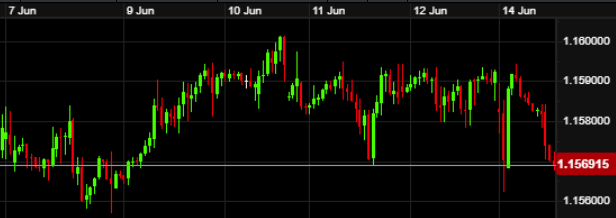
Movements on GBP-EUR last week were limited, as shown below:
The week ahead:
Monday – ECB Lagarde speech (08:30), G7 Meetings (Mon-Wed)
Tuesday – BoJ rate announcement (03:30), RBA rate announcement (05:30), EU ZEW Economic Sentiment (10:00)
Wednesday – UK CPI Inflation (07:00), EU Final CPI inflation (10:00), Fed rate announcement (19:00) & Press Conference (19:30)
Thursday – SNB rate announcement (08:30), BoE rate announcement (12:00)
Friday – UK Retail Sales (07:00), US BANK HOLIDAY
Given the US-Iran deal reached this morning, the focus this week is likely to be back on the policy decisions facing central banks. The outlook of these will have changed slightly though given the successful peace talks.
From the central banks making decisions this week (Japan, Australia, US, UK, Switzerland), we only expect a possible interest rate hike to come from Japan. This is dual-purpose from Tokyo, both to boost the weakening Yen and to protect the domestic economy from worsening inflationary risks.
The Federal Reserve meeting, whilst expected not to change policy, is more of an unknown as the meeting is the first for new chair Kevin Warsh. That said, having been appointed by Trump we don’t expect the new leader to upset the President with a rate hike straight out of the blocks. The announcement is on Wednesday at 19:00 UK time, followed by Warsh’s inaugural press conference after at 19:30.
UK inflation is also ticking upwards, perhaps to 3.0% if the estimate for this week’s May publication is to be believed. Such a move is unlikely to see the Bank of England raise interest rates this time around, but anything substantially above that may raise questions. The BoE announcement comes at midday on Thursday.
With peace talks (seemingly) coming to a conclusion this week on the Middle East conflict, we may well see further USD weakness to come. Do reach out to the team to discuss any pending currency requirements you may have, especially those Dollar-related.
Have a great week.
