
ACM Update 05-01-26
With plenty of currency market action in 2025, the new year is now in full swing and currency markets are ramping up again. We take a look back at the major movers behind GBP, EUR and USD over the last 12 months, as well as looking forwards to what might be on the horizon this year.
How many more rate cuts are there to come from the Federal Reserve? Will the divided voting pattern from the Bank of England continue and how will that impact GBP? Are the European Central Bank at their neutral level for interest rates already?
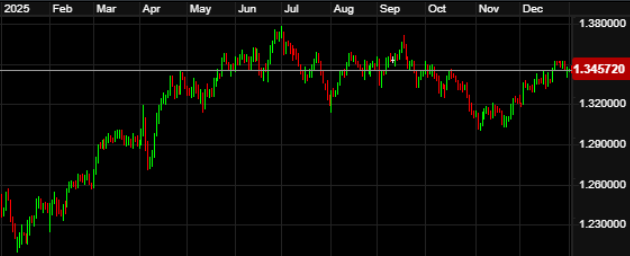
Starting off on home soil, GBP had a better year than of late against the US Dollar. The pair traded in a wide range of over 13% during the twelve months, hitting a high close to 1.38 at one stage. The consistent gains saw GBP close 7.5% up on USD for the period, marking the strongest annual performance for the Pound versus the Dollar since 2017.
As always, much of this came from differing monetary policy approaches on both sides of the Atlantic, combined with the impact of a certain Donald J Trump’s tariffs in the US. Nerves about the state of the US economy were also a factor.
UK monetary policy was more of a “keep calm and carry on” approach in 2025, as the Bank of England continued their telegraphed “cautious and gradual” stance. This saw four interest rate cuts materialise, one per quarter of 25 basis points each. Despite an expected bounce back up in inflation after the summer, the Bank’s committee stuck to their guns.
But it wasn’t all plain sailing. The recent rate decisions have seen a split in opinions on what to do with interest rates. The last three meetings of the year delivered a 5-4 split from the nine members, with Governor Andrew Bailey holding the casting vote. This split has led markets to be less clear on further UK interest rate cuts to come, offering some support to GBP in the latter portion of the year.
UK inflation was a major factor in the indecisiveness of the Bank of England committee. The metric experienced a resurgence during the year, before cooling rapidly in Q4. Food price increases remain a concern, along with energy bills. The OBR still expects inflation to remain above the 2% mandate all the way through to the end of 2026.
UK economic performance wasn’t much to shout about either, despite the best efforts of the Chancellor. Q1 started off well with 0.7% growth, whilst a sharp slowdown saw 0.3% and 0.1% achieved in the following two quarters. Tax changes creating caution in hiring, as well as a cyber attack at Jaguar Land Rover impacting manufacturing/production, were seemingly the major factors. But overall, the economy was sluggish.
The October Budget was feared by many, but the leaky publication didn’t detract from the fact that it wasn’t “as bad” as some had feared. The apprehension in the weeks beforehand though, didn’t help consumer confidence, nor spending. Will that have further dented economic output when the Q4 figures are published?
Despite the lack of inspiring data and cautious policy, GBP performed well against the Dollar, consistently marching upwards throughout most of the year. Overall movements on GBP-USD during the last 12 months can be seen in the chart below:
The Dollar was, as one would expect, largely driven by the actions of Trump. The returning President started his second term in January and by April had launched his now famous flipchart of tariffs. The move meant a mad rush almost globally to get ahead of the tariffs in Q1 flattering economic figures, followed by a slump ongoing.
Despite a Trump-promised “new golden age” for the economy, US data was volatile to say the least. Q1 delivered a contraction in GDP, before Q2 & Q3 delivered expansion of 3.8% and 4.3% (annualised) respectively. The latter was the strongest performance in two years. Robust consumer spending, increased exports and government spending formed much of the growth, as well as AI investment. Overall, US growth for 2025 is projected at approximately 3.0%.
The Government shutdown and concerns about the jobs market that caused nervousness. Monthly jobs added to the US economy averaged just 55,000, which was a 67% decrease on the year before. The unemployment rate hit 4.6% in November (the highest in four years), whilst corporate layoffs were their highest since the pandemic. This weakened the Dollar in the second half of the year.
But it was the action of the Federal Reserve in cutting interest rates that saw the Dollar falling towards year end. Despite pressure to cut rates from Trump, the Fed held firm for the first five decisions of 2025, before delivering three consecutive quarter-point cuts in September, October and December.
Ongoing concerns about the impact of tariffs were also Dollar-negative, and jobs market concerns remain. Will these lead to some larger interest rate cuts to come from the Federal Reserve in 2026?
The elephant in the room also remains about the independence of the Fed. Trump is due to name Jerome Powell’s successor soon, a move which will likely see someone more aligned to his own policy ideals at the helm. The integrity of US data also remains under the microscope, after Trump unceremoniously fired the head of the Bureau of Labor Statistics in the summer, following weak data.
The first year of Trump 2.0 was certainly volatile for the Dollar. That is expected to remain the case in 2026.
Despite the volatile global trade environment, the Eurozone economy remained resilient last year. Inflation remained close to the 2% target for most of the year, allowing the ECB’s rate-setters to focus on economic growth instead. However, this remained relatively sluggish overall.
With inflation under control, all of the ECB’s rate cuts came in the first half of the year, before interest rates remained at their 2.0% level from June all the way through to December. There is general speculation that the committee may be done with their rate cuts for now.
Q1 saw the aforementioned front-loading of orders prior to the US tariffs kicking in, which boosted GDP. But the Q2 number was only just positive, before a slight rebound in Q3. Spain contributed the most in terms of the larger economies with 2.9% growth for the year, whilst Germany recorded just 0.2% worth of expansion, hampered by high energy costs.
As mentioned by ECB Chief Christine Lagarde on a number of occasions, the Eurozone was viewed favourably as a trade alternative to the US Dollar. Such investment led to record low unemployment, growth in real wages, and a general uptick in employment expectations in the latter part of the year.
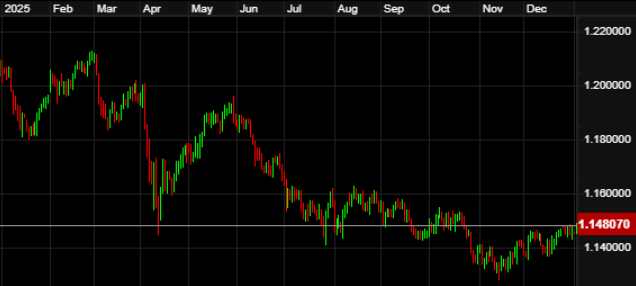
The policy divergence between the big three central banks (BoE, Fed, ECB) meant that the respective currencies were stronger at various points of the year. Overall, the Euro looked to be the better performer of the three. For the year, the single currency gained approximately 5.5% versus GBP, as well as ending 14% up against the weakening Dollar.
Annual movements on GBP-EUR can be seen in the chart below:
The week ahead:
Monday – UK Mortgage Approvals (07:00), US Manufacturing (15:00)
Tuesday – EU/UK/US Services PMIs (07:45-14:45), Fed Barkin speech (13:00)
Wednesday – Australian CPI (00:30), EU CPI (10:00), US ADP Non-Farm Employment (13:15), US JOLTS Jobs data & ISM Service PMI (15:00), Fed Bowman speech (18:10)
Thursday – Swiss CPI inflation (07:30), US Unemployment Claims (13:30)
Friday – EU Retail Sales (10:00), US Non-Farm Payrolls & Unemployment rate (13:30), UoM Consumer Sentiment & Inflation Expectations (15:00)
For the coming year, markets are cautiously optimistic for GBP’s prospects against the Dollar. This is generally driven by the expectation of further interest rates to come from the US, as well as a weaker Dollar. In terms of confidence in the Pound itself, this remains low in light of economic growth concerns as well as the financial black hole that the UK Chancellor still finds herself in.
Given the resilience of the Euro and the likelihood of no further interest rate cuts to come on the continent, GBP may struggle to gain much ground here. Current expectations are for similar levels than seen of late on the pair, in the mid to low teens.
Interest rates are, as always, a major factor behind the above predictions also. With a couple of UK rate cuts priced in already, any further slowdown in the economy could add to that. Growth is predicted to be around 1.1% this year, and even that may be a stretch. Political factors such as a potential leadership challenge in Number 10, would also create volatility and downside risks.
For the Dollar, the forecast interest rates to come from the Federal Reserve in 2026 are pointing towards a gradual decline for the currency. Two or three rate cuts are currently expected, but a Trump-installed head of the Fed certainly has the potential to increase that number. Geopolitics will also be a factor. The Dollar will remain the focal currency as always.
The Euro meanwhile looks to stay the currency of choice in 2026. With a small possibility of one rate cut to come this year, if any, monetary policy stability and inflation under control will help the single currency. That and the Eurozone being a viable investment alternative to the US, should see another good year for EUR.
As with all of the above, things can change in a heartbeat in the FX market. Thus, the new year is as prudent a time as any to reach out to the team here for discussions on pending FX requirements. Do let us know if you have anything we can assist with.
Have a great week and all the best for 2026.
